
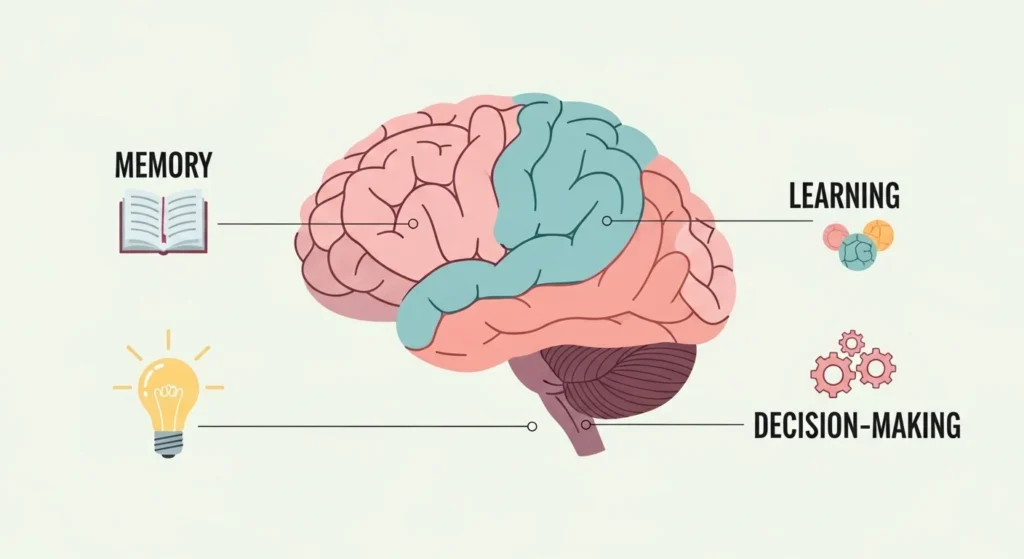

Cognitive means related to mental processes such as thinking, learning, understanding, memory, and decision-making. It describes how the brain processes information and helps you make sense of the world.
The word “cognitive” shows up everywhere.
You’ll hear it in school, psychology, health, and even everyday conversations.
It might sound complex at first, but the meaning is actually simple.
So what does cognitive really mean in practical terms?
And how can you understand or use it without confusion?
Let’s break it down in a clear and relatable way.
What Does Cognitive Mean? (Simple Explanation)
At its core, cognitive is all about how your brain works.
It focuses on thinking, learning, and understanding.
Key Idea
- Anything related to mental activity is cognitive
Examples of Cognitive Functions
- Thinking
- Learning
- Memory
- Problem-solving
- Decision-making
- Attention
In simple terms, if your brain is processing something, it’s cognitive.
Origin of the Word Cognitive
The word cognitive comes from Latin.
It is derived from the word “cognoscere,” which means “to know.”
How It Evolved
- Latin roots meaning “to know”
- Later used in philosophy and psychology
- Became common in education and science
Today, the term is widely used in many fields.
Why the Word Cognitive Is Important
Understanding cognitive helps you understand how people think.
It also explains how learning and behavior work.
Key Reasons
- Used in education to describe learning processes
- Important in psychology and mental health
- Helps explain memory and intelligence
- Common in child development discussions
Because of this, the word appears often in both academic and everyday language.
How Cognitive Is Used in Real Life
You’ll hear cognitive in different situations.
It often appears in formal or semi-formal contexts.
Common Situations
- Education and schools
- Psychology and therapy
- Health and brain development
- Workplace training
Tone and Context: What Does Cognitive Feel Like?
The word cognitive has a neutral and professional tone.
It is not slang or casual language.
1. Academic Tone
Used in studies or research.
“Cognitive development is important in early childhood.”
2. Professional Tone
Used in workplaces or training.
“This task requires strong cognitive skills.”
3. Health-Related Tone
Used in medical or mental health discussions.
“He is working on improving cognitive function.”
4. Everyday Informational Tone
Sometimes used in general conversations.
“Reading helps improve cognitive ability.”
Labeled Examples of Cognitive Usage
| Context | Example Sentence | Meaning |
|---|---|---|
| Education | “Cognitive skills develop in early years.” | Mental development |
| Workplace | “This job needs cognitive ability.” | Thinking skills |
| Health | “Exercise improves cognitive function.” | Brain performance |
| Daily use | “Games boost cognitive skills.” | Mental activity |
| Psychology | “Cognitive behavior affects actions.” | Thinking patterns |
Cognitive in Different Fields
1. Psychology
In psychology, cognitive relates to how people think.
It includes memory, perception, and reasoning.
2. Education
Teachers use the term to describe learning abilities.
It focuses on how students process information.
3. Health and Medicine
Doctors use it to describe brain function.
It often relates to memory or mental clarity.
4. Workplace and Skills
Employers use it to describe thinking ability.
It includes problem-solving and decision-making.
Comparison: Cognitive vs Similar Terms
Understanding similar words makes things clearer.
Cognitive vs Mental
| Cognitive | Mental |
|---|---|
| Focuses on thinking processes | Broader term |
| More technical | More general |
Intellectual vs Cognitive
| Cognitive | Intellectual |
|---|---|
| Basic thinking processes | Higher-level thinking |
| Includes memory and attention | Focuses on intelligence |
Cognitive vs Emotional
| Cognitive | Emotional |
|---|---|
| Related to thinking | Related to feelings |
| Logical processes | Emotional responses |
Alternate Meanings of Cognitive
The word cognitive usually has one main meaning.
However, it can appear in different phrases.
Common Related Terms
- Cognitive skills
- Cognitive development
- Cognitive function
- Cognitive ability
All of these refer to brain-based processes.
Polite or Simple Alternatives to Cognitive
Sometimes the word can feel too technical.
In those cases, simpler alternatives work better.
Instead, Use:
- Thinking skills
- Brain function
- Learning ability
- Mental skills
- Understanding
Example:
Instead of: “Cognitive development is important”
Say: “Thinking skills are important.”
Do’s and Don’ts of Using Cognitive
Do
- Use it in educational or professional contexts
- Understand it refers to mental processes
- Use it when discussing learning or thinking
Don’t
- Use it casually without context
- Confuse it with emotional terms
- Overcomplicate simple explanations
Frequently Asked Questions (FAQ)
1. What does cognitive mean in simple words?
It means related to thinking and understanding.
It involves how your brain processes information.
2. What are cognitive skills?
They are mental abilities like memory, attention, and problem-solving.
3. Is cognitive the same as mental?
Not exactly.
Cognitive is more specific and focuses on thinking processes.
4. What does cognitive function mean?
It refers to how well your brain works.
This includes memory, focus, and reasoning.
5. Can cognitive skills improve?
Yes, they can improve with practice.
Activities like reading and puzzles help.
6. Is cognitive related to intelligence?
Yes, but it is broader.
It includes basic thinking processes, not just intelligence.
7. Where is cognitive used most?
It is common in education, psychology, and health fields.
8. Can I use cognitive in daily conversation?
Yes, but it may sound formal.
Simpler words may be better in casual talk.
Why Cognitive Matters in Everyday Life
Understanding cognitive helps you understand how the brain works.
It also explains how people learn and make decisions.
This knowledge is useful in many areas of life.
It can improve learning, communication, and problem-solving.
Conclusion: Key Takeaways About Cognitive Meaning
- Cognitive relates to thinking and mental processes
- It includes memory, learning, and decision-making
- Common in education, psychology, and health
- Has a formal and professional tone
- Can be replaced with simpler terms in casual use
In simple terms, cognitive describes how your brain works and processes information.
Understanding it makes learning and communication much easier.