
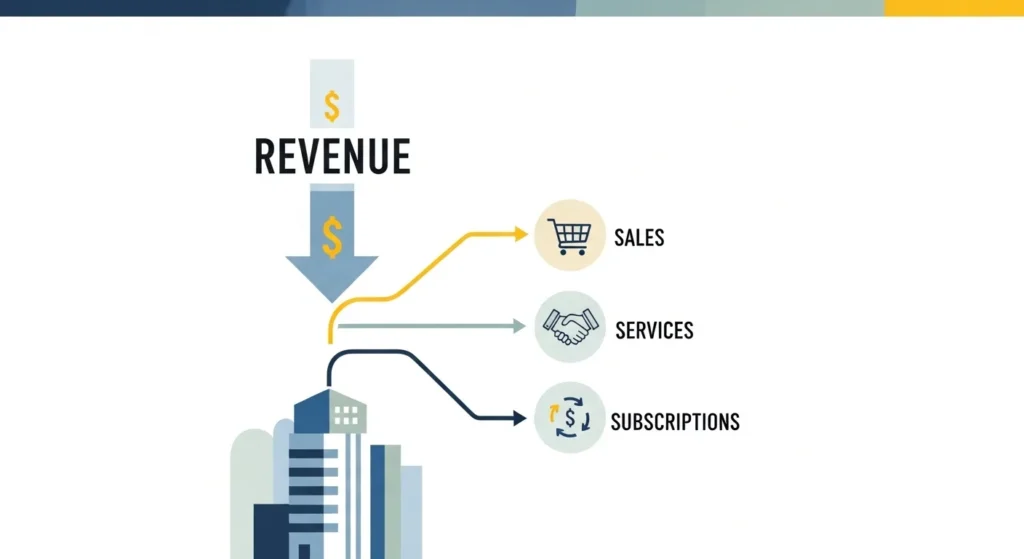

Revenue is the total amount of money a business earns from its normal operations, such as selling products or services, before any expenses are deducted.
Money comes into every business in different ways.
Some companies sell products, while others offer services.
No matter the model, one term always shows up: revenue.
You’ve probably heard phrases like “the company increased its revenue” or “monthly revenue is growing.”
But what does revenue actually mean in simple terms?
And how is it different from profit?
This guide breaks it down clearly so you can understand it without confusion.
What Does Revenue Mean? (Simple Explanation)
At its core, revenue is the income a business generates.
It represents all the money coming in.
Key Idea
- Revenue = Money earned before expenses
- It does not include costs, taxes, or deductions
- Often called “top-line income”
For example, if a shop sells products worth $1,000 in a day, its revenue is $1,000.
It doesn’t matter how much was spent to make those products.
Types of Revenue
Businesses can earn revenue in different ways.
Understanding the types helps clarify how money flows in.
1. Operating Revenue
This comes from the main business activity.
- Selling products
- Providing services
- Subscription fees
Example: A clothing store selling shirts.
2. Non-Operating Revenue
This comes from secondary activities.
- Interest earned
- Investment income
- Selling assets
Example: A company earning money from investments.
3. Recurring Revenue
This is predictable and repeated income.
- Monthly subscriptions
- Membership fees
- Software plans
Example: A streaming service charging monthly.
4. One-Time Revenue
This happens only once.
- Single product sale
- Special deals
- Event-based income
Example: Selling a car.
Revenue vs Profit (Important Difference)
Many people confuse revenue with profit.
They are not the same.
| Revenue | Profit |
|---|---|
| Total money earned | Money left after expenses |
| Does not include costs | Includes all costs deducted |
| Top-line figure | Bottom-line figure |
Simple Example
- Revenue = $1,000
- Expenses = $700
- Profit = $300
Revenue shows how much you earned.
Profit shows how much you kept.
Why Revenue Is Important
Revenue is one of the most important business metrics.
It shows how well a business is performing.
Key Reasons
- Measures business growth
- Helps track sales performance
- Attracts investors
- Indicates demand for products or services
Higher revenue often means the business is growing.
However, it does not always mean the business is profitable.
How Revenue Is Used in Real Life
You’ll hear the word revenue in many situations.
It is common in business, finance, and everyday discussions.
Common Examples
- “The company increased its revenue this year.”
- “Our monthly revenue is stable.”
- “They are focusing on revenue growth.”
Revenue in Different Industries
Revenue exists in every type of business.
The source may change depending on the industry.
Retail
- Revenue comes from product sales
Service Businesses
- Revenue comes from client payments
Tech Companies
- Revenue comes from subscriptions or ads
Freelancers
- Revenue comes from project payments
Labeled Examples of Revenue
| Situation | Example | Revenue Source |
|---|---|---|
| Online store | Sold 10 items for $20 each | Product sales |
| Freelancer | Completed a $500 project | Service income |
| App business | 100 users pay $10/month | Subscription |
| Investor | Earned $200 interest | Non-operating |
Alternate Meanings of Revenue
The word revenue is mostly used in finance.
It has a consistent meaning across industries.
- Government revenue (tax collection)
- Business revenue (sales income)
- Personal context is rarely used
In all cases, it refers to money coming in.
Polite or Professional Alternatives to Revenue
In formal or casual conversations, you may use similar terms.
These depend on context.
Alternatives
- Income
- Earnings
- Sales
- Turnover
- Receipts
Example
Instead of: “Company revenue increased”
You can say: “Company income increased.”
Do’s and Don’ts of Understanding Revenue
Do
- Remember it means total income
- Separate it from profit
- Use it in financial discussions
Don’t
- Confuse it with earnings after expenses
- Assume high revenue means high profit
- Ignore costs when analyzing revenue
Frequently Asked Questions (FAQ)
1. What does revenue mean in simple terms?
Revenue is the total money a business earns before expenses.
2. Is revenue the same as profit?
No, revenue is total income.
Profit is what remains after expenses.
3. What is an example of revenue?
If a business sells products worth $500, that $500 is revenue.
4. What is revenue in a company?
It is the total money the company earns from its operations.
5. Can revenue be negative?
No, revenue itself is not negative.
Loss happens when expenses exceed revenue.
6. What is monthly revenue?
It is the total income earned in one month.
7. Why is revenue important?
It shows business performance and growth.
8. What is the difference between revenue and income?
Revenue is total earnings before costs.
Income may sometimes refer to profit depending on context.
Why Revenue Matters in Today’s World
Understanding revenue helps you make better financial decisions.
It is important for business owners, freelancers, and even students.
It also helps you evaluate companies and opportunities.
Knowing revenue gives you a clear picture of financial activity.
Conclusion: Key Takeaways About Revenue
- Revenue is total money earned before expenses
- It is the starting point of financial analysis
- Different types of revenue exist
- It is not the same as profit
- It helps measure growth and performance
In simple terms, revenue is the money coming in.
Understanding it makes financial concepts much easier to grasp.