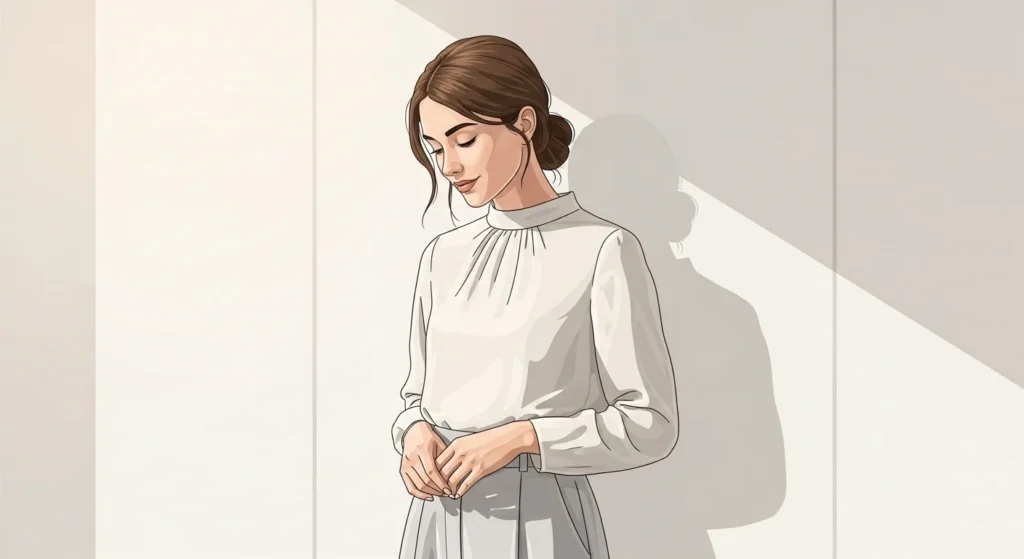

Demure means modest, reserved, and shy in behavior or appearance. It is often used to describe someone who is quiet, polite, and not overly bold or attention-seeking.
The word “demure” has recently made a comeback online.
You might have seen it in captions, comments, or trending videos.
People use it to describe a certain calm, soft, and elegant vibe.
But what does demure actually mean in real life?
And how can you use it correctly without sounding outdated or awkward?
Let’s break it down in a simple and relatable way.
What Does Demure Mean? (Simple Explanation)
At its core, demure describes someone who is reserved and modest.
It often relates to behavior, personality, or even style.
Main Meaning of Demure
- Quiet and calm
- Polite and well-mannered
- Not loud or attention-seeking
- Soft and graceful in appearance
Unlike slang words, demure is a standard English word.
However, its usage has evolved with modern trends.
Origin of the Word Demure
The word demure has a long history.
It comes from Middle English and Old French origins.
Where It Started
- Derived from Old French “demourer” meaning “to remain”
- Originally described someone serious or composed
- Later evolved to mean modest and reserved
How It Became Popular Again
Recently, social media brought the word back into focus.
People now use it to describe a soft and elegant aesthetic.
As a result, demure feels both classic and trendy at the same time.
Why Demure Is Trending Online
The rise of aesthetics and personality-based trends has boosted its usage.
It fits perfectly with calm and minimal lifestyles.
Key Reasons
- Popularity of “soft girl” and minimal aesthetics
- Desire for calm and composed personalities
- Social media trends focusing on elegance
- Contrast to loud and bold online behavior
Because of this, demure has become a stylish compliment.
How Demure Is Used in Real Life
You can use demure in both online and offline conversations.
It works well when describing people, behavior, or style.
Common Situations
- Complimenting someone’s personality
- Describing fashion or appearance
- Talking about calm behavior
- Writing captions or comments
Tone and Context: What Does Demure Feel Like?
The tone of demure is generally positive.
It often carries a sense of respect and admiration.
1. Complimenting Tone
Used to praise someone’s elegance.
“She has such a demure personality.”
2. Descriptive Tone
Used to describe behavior or style.
“He spoke in a calm and demure way.”
3. Aesthetic / Social Media Tone
Used in captions or trends.
“A soft and demure look for today.”
4. Slightly Old-Fashioned Tone
Sometimes it may sound formal.
“The character was quiet and demure.”
Labeled Examples of Demure Usage
| Context | Example Sentence | Meaning |
|---|---|---|
| Compliment | “She looked demure in that outfit.” | Modest and elegant |
| Behavior | “He remained demure during the meeting.” | Calm and reserved |
| Social media | “Feeling demure today.” | Soft and minimal vibe |
| Description | “A demure smile.” | Gentle and subtle |
| Writing | “The character was shy and demure.” | Reserved personality |
Demure in Different Contexts
1. Everyday Conversations
Used to describe someone’s personality.
It often highlights calm and polite behavior.
2. Fashion and Appearance
Describes modest and elegant style.
Clothing that is simple and not flashy fits this term.
3. Social Media Trends
Often used in captions and aesthetics.
It represents a soft and minimal lifestyle.
Comparison: Demure vs Similar Words
Understanding similar words helps clarify its meaning.
Demure vs Shy
| Demure | Shy |
|---|---|
| Polite and reserved | Lacks confidence |
| Often positive | Can be neutral or negative |
Modest vs Demure
| Modest | Demure Modest |
|---|---|
| Mostly attitude or humility | Behavior and appearance |
| More general term | Softer tone |
Demure vs Reserved
| Demure | Reserved |
|---|---|
| Gentle and elegant | Emotionally distant |
| Warmer tone | More neutral |
Alternate Meanings of Demure
The word demure mainly has one meaning.
However, tone can change slightly based on context.
- Traditional: Quiet and modest
- Modern: Soft, aesthetic, elegant vibe
- Literary: Reserved and composed character
Polite or Professional Alternatives to Demure
In formal settings, you may prefer more neutral words.
These can fit better depending on context.
Instead, Use:
- Reserved
- Modest
- Polite
- Composed
- Soft-spoken
Example:
Instead of: “She is demure”
Say: “She is polite and composed.”
Do’s and Don’ts of Using Demure
Do
- Use it as a compliment
- Apply it to behavior or style
- Keep tone respectful
Don’t
- Use it to insult someone
- Confuse it with weakness
- Overuse it in casual chat
Frequently Asked Questions (FAQ)
1. What does demure mean in simple words?
It means modest, quiet, and reserved.
2. Is demure a compliment?
Yes, it is usually a positive description.
3. Can demure describe clothing?
Yes, it can describe modest and simple fashion.
4. Is demure the same as shy?
Not exactly.
Demure is more positive and graceful.
5. Can men be described as demure?
Yes, the word can be used for anyone.
6. Is demure an old-fashioned word?
It is traditional but still widely used today.
7. Why is demure trending?
Social media trends and aesthetics made it popular again.
8. Can I use demure in professional settings?
Yes, it is appropriate in formal communication.
Why Demure Matters in Today’s Digital World
Modern communication values personality and aesthetics.
Words like demure help describe calm and refined behavior.
It also reflects a shift toward softer expressions online.
People often use it to highlight elegance and simplicity.
Conclusion: Key Takeaways About Demure Meaning
- Demure means modest, reserved, and calm
- It is a positive and respectful description
- Common in fashion, personality, and social media
- Works in both casual and formal contexts
- Reflects elegance and simplicity
In simple terms, demure describes someone who is quietly confident and graceful.
Using it correctly adds depth and clarity to your communication.