

The barrel chair earns its name from a simple, defining feature. Its curved back wraps around the seated person, tracing the shape of a rounded barrel and creating a quiet sense of enclosure. This is not a new design. Its lineage stretches back through decades of interior fashion, yet it continues to appear in living rooms, reading nooks, and hospitality spaces without losing its relevance. Part sculptural object, part practical seating, the barrel chair holds a rare position in furniture design. It is comfortable enough to use every day, striking enough to anchor a room, and adaptable enough to suit both traditional interiors and modern minimalist spaces.
What Defines a Barrel Chair
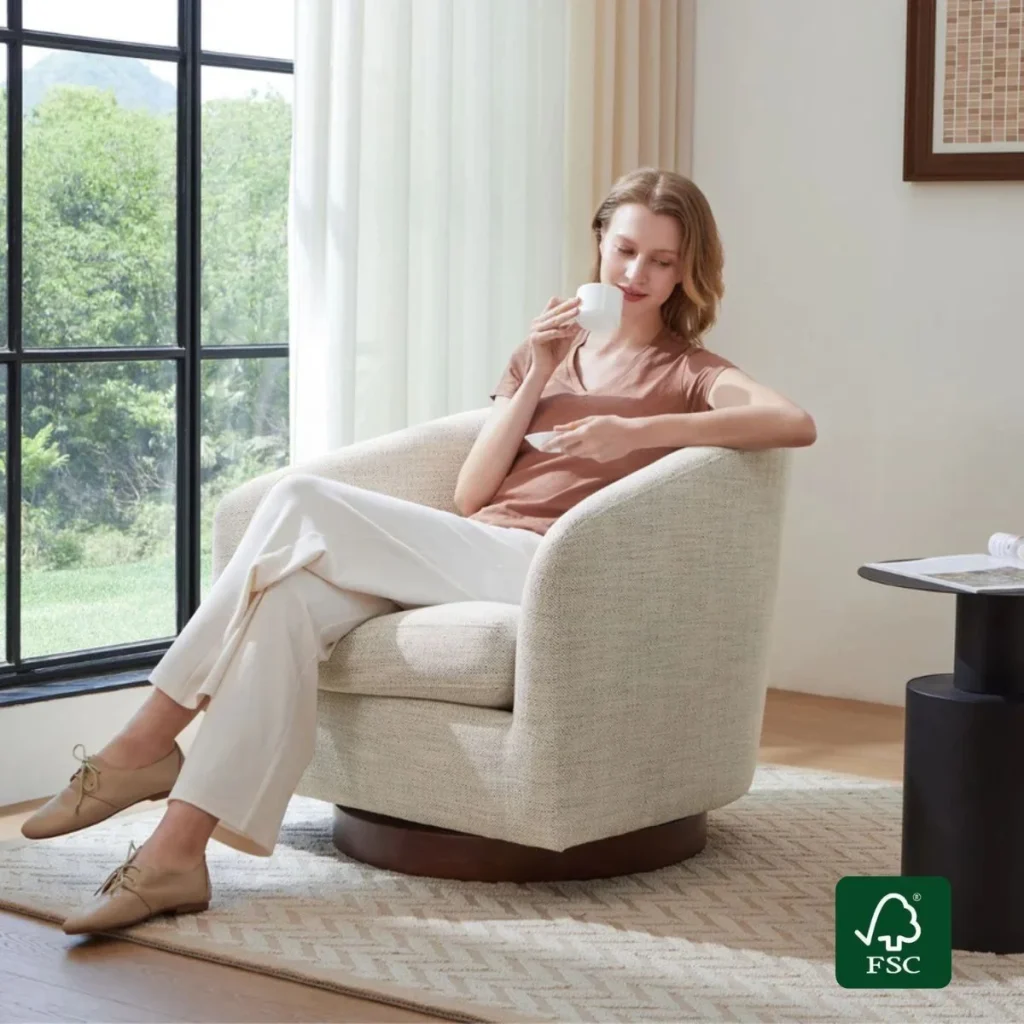
The signature feature is the continuous curve. Unlike a wingback or a standard armchair, a barrel chair does not separate its arms from its back. Instead, the backrest sweeps around in a single arc, dipping slightly toward the front and forming built-in armrests as it goes. The result is a compact, sculptural silhouette that feels enclosed without being oversized. Most designs sit lower than a traditional lounge chair, and the seat depth encourages an upright, engaged posture rather than a slouched one.
The shape does more than look distinctive. It performs a functional role. The wraparound back cradles the shoulders, softens conversation acoustics in a corner, and creates a sense of personal space in an otherwise open room. Because the frame is so contained, the chair reads as a single object from every angle. This visual completeness is one reason designers reach for a barrel chair when a room needs a punctuation mark rather than a longer statement of upholstery.
A Short History of a Long-Lasting Silhouette
The barrel chair traces its origins to early twentieth-century American furniture making, though its curved-back cousins appeared in European club chairs decades earlier. The mid-century revival gave the form new life, when designers embraced tighter footprints and sculptural upholstery. By the time modern interior design shifted toward open floor plans and multipurpose living areas, the barrel chair had already proven it could stand alone as a lounge piece or work in pairs flanking a fireplace, sofa, or window.
What has kept the silhouette alive is its neutrality. It does not belong exclusively to any single decade or design movement. Traditional interiors accept it. Transitional rooms treat it as flexible. Contemporary spaces use it as a soft counterweight to hard architecture. The barrel chair has outlasted many trend cycles precisely because it commits to a shape rather than a style, leaving upholstery, base, and finish to carry the decorative message.
Materials and Construction
Beneath the fabric, the anatomy of a barrel chair matters more than most buyers realize. The frame is typically hardwood, engineered for the sustained tension a curved back demands. Cheaper versions substitute softwood or particleboard, which flex over time and pull the upholstery out of shape. Reinforced joinery keeps the arms and back rigid where they meet the seat rail, and this junction is where quality either shows or fails.
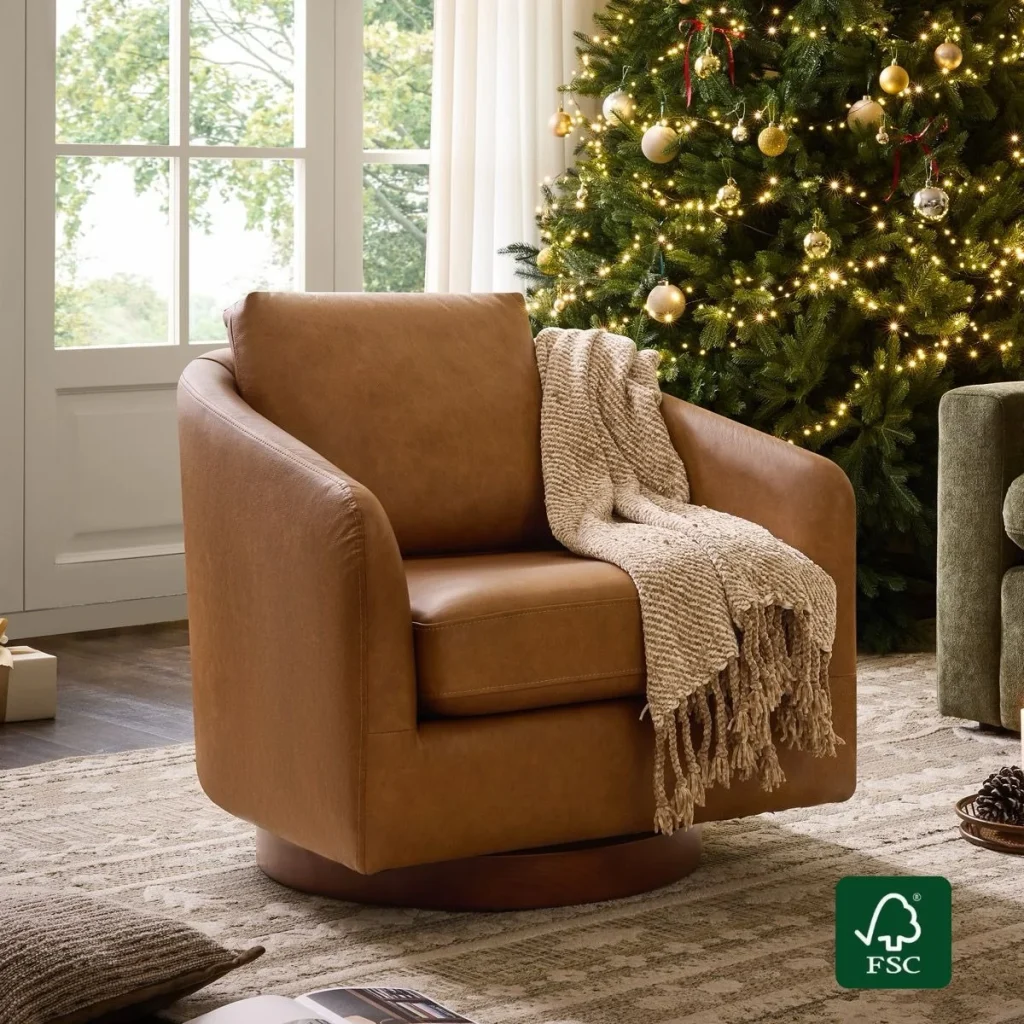
Padding decisions define the feel. High-density foam holds the sculptural line but stays firm underneath, while wrapped foam over sinuous springs offers a softer landing. The seat cushion may be a single piece or a two-part configuration, though many barrel chairs use a fixed seat to preserve the clean, uninterrupted silhouette. Fabric choice then determines personality. Boucle brings texture and softness, velvet emphasizes richness, leather adds structure and patina, and woven performance fabrics fit households where durability leads.
Swivel, Static, and the Question of Motion
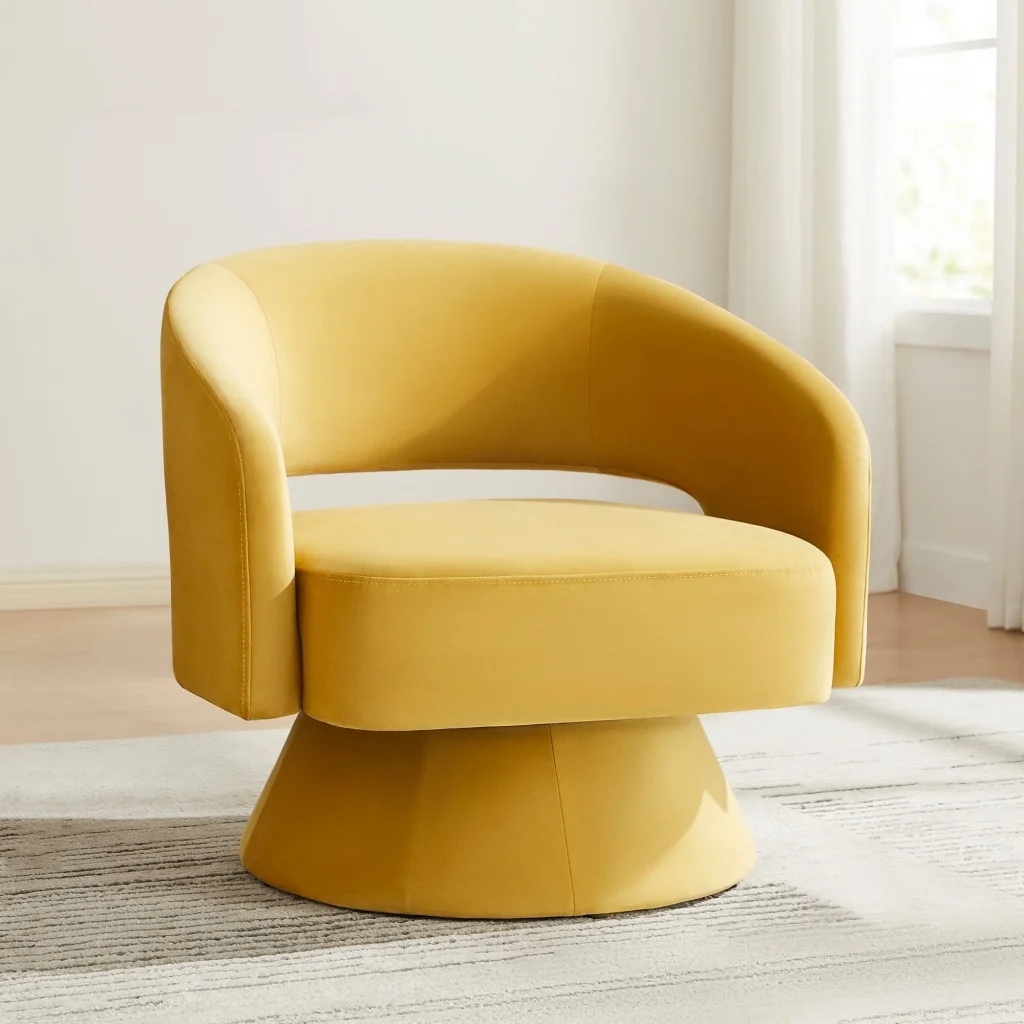
Modern barrel chairs often introduce a swivel base, and this small mechanical detail changes the way the chair lives in a room. A static chair anchors a spot. A swivel chair invites participation. In a living area with more than one conversational focus, such as a television on one wall and a fireplace on another, a swiveling barrel chair reduces the need to reposition furniture. The occupant simply turns.
The base itself becomes a design element. A metal disc keeps the profile low and industrial. A pedestal in wood or matte finish leans traditional. A hidden mechanism under a fully upholstered skirt reads more classic, while an exposed metal swivel emphasizes contemporary lines. Static versions, meanwhile, may rest on turned wooden legs, tapered supports, or a solid plinth. Each choice shifts the character of the piece without touching the wraparound back that gives the barrel chair its identity.
Placing a Barrel Chair in a Room
The compact footprint is a strategic advantage. A barrel chair fits where a full lounge chair or recliner cannot. It slides into a bedroom corner beside a floor lamp and a small side table, creating a reading spot without dominating the space. It works at the foot of a bed as an occasional seat. In a home office, it offers a break from a task chair without pretending to be a sofa. In a formal living room, a pair of barrel chairs facing a sofa creates a symmetrical conversation area that feels considered rather than crowded.
Scale matters. Because the chair reads as a single sculptural volume, it competes visually with any other rounded or bulky object nearby. Pair it with a rectilinear side table for contrast, or echo the curve with a round pedestal to reinforce the geometry. Beneath a large piece of art or a bold wallpaper, a barrel chair in a quieter tone lets the wall do the work. Against a plain backdrop, the chair itself becomes the focal point, and a saturated fabric or unusual texture will pay off.
Fabric, Color, and Longevity
Because the barrel chair is compact and sculptural, its upholstery reads at close range. Every detail of texture and stitching is visible. A crisp welt line emphasizes the curve. A tight upholstery pull keeps the silhouette sharp. Loose or puckered fabric flattens the sculptural quality and makes the chair look older than it is. This is one reason well-made barrel chairs from established makers, including CHITA LIVING, hold their appearance over years of daily use.
Color choice is a longevity decision. Deep neutrals like charcoal, olive, camel, and dusty blue tend to outlast bolder statements in most homes. That said, the barrel chair is one of the safer places to try a saturated tone or a specialty texture, precisely because it is a single accent piece rather than a large-scale investment like a sofa. If the color falls out of favor, reupholstering a barrel chair is a smaller project than reupholstering a sectional, and the frame usually justifies the effort.
Comfort in a Compact Form
A common assumption is that smaller chairs are less comfortable. The barrel chair pushes back on that idea. The enclosed back offers real lumbar and shoulder support, and the natural forward tilt of a well-designed seat encourages an active sitting posture that works for reading, conversation, or working from a laptop. It is not the chair for a two-hour nap. It is the chair that keeps a person present, comfortable, and slightly upright while doing something else. That distinction matters when choosing furniture for a room where people actually spend time rather than simply pass through.
Ergonomics vary by manufacturer. Seat height, seat depth, and back angle all influence how a barrel chair feels once occupied. Trying a chair in person, when possible, reveals differences that photographs cannot show. When shopping online, dimensional information and honest customer reviews from CHITA LIVING and other established brands help narrow the field. Return policies matter, because comfort is personal and the geometry of a chair either agrees with a body or does not.
Pairing and Multiples
A single barrel chair works. A pair works differently. Two barrel chairs facing a sofa establish a formal, symmetrical arrangement that reads intentional and welcoming. Two chairs facing each other with a small table between them create a dedicated conversation zone or a spot for morning coffee. In larger rooms, four barrel chairs around a low round table can replace a sofa entirely, offering a flexible seating arrangement that adapts to guests, games, or a change of mood without any furniture-shuffling.
When mixing a barrel chair with existing seating, contrast the shapes. A rectangular sofa gains dynamism next to a curved chair. A tufted or channel-back sofa relaxes when paired with a smooth-backed barrel chair. Avoid duplicating strong sculptural forms in the same visual line, because the eye needs a resting point among curves.
Why the Shape Endures
The barrel chair endures because it solves a specific set of design problems with a single, confident shape. It offers real comfort in a compact footprint, contributes sculptural interest without competing for attention, and adapts to changing rooms, styles, and households without needing to be replaced. Whether upholstered in linen for a coastal bedroom, leather for a study, or velvet for a formal sitting room, the wraparound silhouette carries its own quiet authority. Trends will come and go, but the barrel chair keeps doing what it has always done. It gives a room a place to sit, a shape to look at, and a design decision that ages well.
