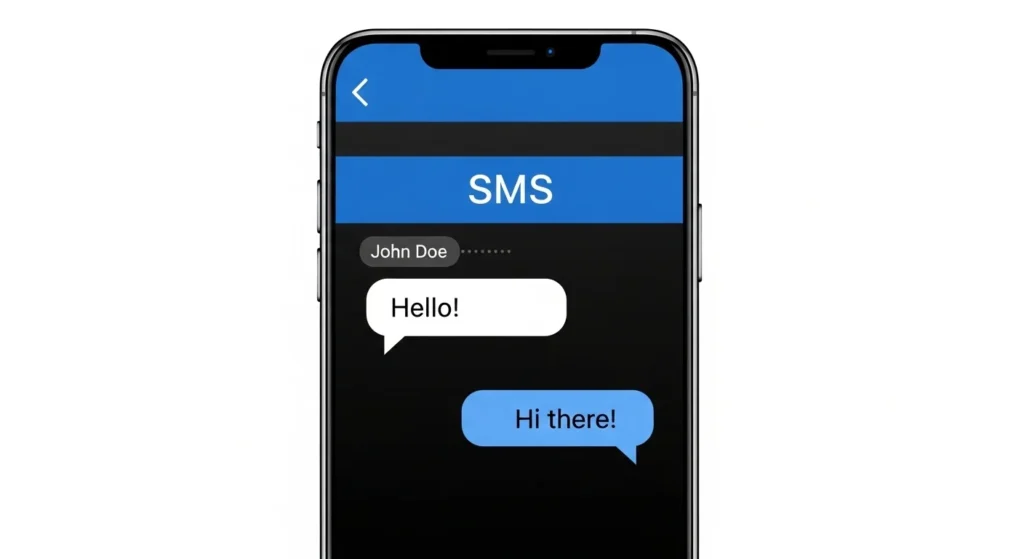

SMS (in text) stands for “Short Message Service.” It refers to standard text messages sent between mobile phones using a cellular network, without needing internet access.
Texting has become a core part of daily communication.
From quick updates to long conversations, people rely on messages more than ever.
In this space, terms like SMS appear frequently.
You might see someone say “send me an SMS” or “I’ll text you via SMS.”
It sounds simple, but many people still wonder how it differs from other messaging types.
Understanding it properly helps you communicate more clearly.
This guide explains SMS meaning in text in a clear and practical way.
What Does SMS Mean in Text? (Simple Explanation)
At its core, SMS refers to basic text messaging.
It works through your mobile network instead of the internet.
Key Points About SMS
- Stands for Short Message Service
- Used for sending text messages between phones
- Does not require Wi-Fi or mobile data
- Usually limited to 160 characters per message
Unlike modern apps, SMS is simple and universal.
Almost every mobile phone supports it.
Origin of SMS
SMS has been around for decades.
It played a major role in early mobile communication.
Where It Started
- Developed in the 1980s as part of GSM standards
- First SMS sent in 1992
- Became popular in the early 2000s
How It Evolved
As smartphones developed, messaging apps grew.
However, SMS remained widely used.
It is still important for alerts, verification, and basic texting.
Why SMS Is Still Popular
Even with apps like WhatsApp and Messenger, SMS remains relevant.
It offers reliability that internet-based apps sometimes cannot.
Key Reasons
- Works without internet connection
- Supported on all mobile devices
- Used for OTPs and verification codes
- Reliable for emergency communication
Because of this, SMS continues to be essential worldwide.
How SMS Is Used in Real Life
You encounter SMS in many everyday situations.
It is often used for quick and direct communication.
Common Uses
- Sending personal messages
- Receiving bank alerts
- Getting verification codes
- Appointment reminders
- Delivery notifications
Tone and Context of SMS
Unlike slang, SMS is a technical term.
It usually carries a neutral tone.
1. Informational Tone
Used when explaining communication methods.
“Please confirm via SMS.”
2. Instructional Tone
Used in services or support messages.
“Enter the code sent by SMS.”
3. Casual Tone
Used in everyday conversation.
“I’ll send you an SMS.”
Labeled Examples of SMS Usage
| Context | Example Sentence | Meaning |
|---|---|---|
| Personal chat | “I’ll send you an SMS.” | Regular text message |
| Banking | “You’ll receive an SMS alert.” | Notification message |
| Verification | “Enter the SMS code.” | OTP message |
| Customer service | “We sent an SMS confirmation.” | Service update |
| Reminder | “Appointment details sent via SMS.” | Informational message |
SMS in Different Contexts
1. Personal Communication
People use SMS for simple texting.
It is useful when internet is not available.
2. Business and Services
Companies rely on SMS for important updates.
It ensures messages reach users instantly.
- OTP verification
- Transaction alerts
- Promotions and reminders
3. Emergency Communication
SMS is often used during emergencies.
It works even when data services fail.
Comparison: SMS vs Other Messaging Types
Understanding the difference helps avoid confusion.
MMS vs SMS
| SMS | MMS |
|---|---|
| Text only | Multimedia messages |
| Limited characters | Supports images and videos |
| Basic messaging | Rich content |
SMS vs WhatsApp
| SMS | |
|---|---|
| No internet required | Requires internet |
| Works on all phones | Needs smartphone |
| Basic features | Advanced features |
SMS vs RCS
| SMS | RCS |
|---|---|
| Traditional messaging | Modern messaging standard |
| Limited features | Rich features like read receipts |
| Works everywhere | Not supported on all devices |
Alternate Meanings of SMS
Although SMS usually means Short Message Service, it can have other meanings in different contexts.
- School Management System
- Safety Management System
- Social Media Strategy
In texting, however, it almost always refers to mobile messages.
Polite or Professional Alternatives to SMS
In formal communication, you may want clearer wording.
Using full terms can improve clarity.
Instead, Use:
- Text message
- Mobile message
- Message notification
- Phone message
Example:
Instead of: “Send me an SMS”
Say: “Send me a text message.”
Do’s and Don’ts of Using SMS
Do
- Use it when referring to basic texting
- Keep messages clear and short
- Use it in both casual and professional contexts
Don’t
- Confuse it with internet messaging apps
- Assume it supports media files
- Overuse abbreviations in formal SMS messages
Frequently Asked Questions (FAQ)
1. What does SMS mean in text?
SMS stands for Short Message Service.
It refers to standard text messages sent via mobile networks.
2. Is SMS the same as texting?
Yes, SMS is a type of texting.
It specifically refers to traditional mobile text messages.
3. Does SMS require internet?
No, SMS works without internet.
It uses your cellular network.
4. What is the difference between SMS and WhatsApp?
SMS does not need internet.
WhatsApp requires an internet connection.
5. What is an SMS code?
It is a verification code sent via text message.
It is commonly used for security purposes.
6. Can SMS send pictures?
No, SMS is text-only.
For images, MMS is used instead.
7. Is SMS still used today?
Yes, it is widely used.
It remains important for alerts and verification.
8. Is SMS secure?
SMS is not fully secure.
It is better for basic communication than sensitive data.
Why SMS Matters in Today’s Digital World
Technology keeps evolving.
Still, SMS remains a reliable communication method.
It works without internet and reaches almost every phone.
That makes it essential for both personal and business use.
Conclusion: Key Takeaways About SMS Meaning in Text
- SMS stands for Short Message Service
- It refers to basic text messaging
- Works without internet
- Used for alerts, verification, and communication
- Still relevant in modern digital life
In simple terms, SMS is the foundation of mobile texting.
Even with advanced apps, it continues to play an important role.