
The dream of a lifelong partnership is a cornerstone of the human experience. We all seek that special someone with whom we can navigate the complexities of life, sharing the triumphs and weathering the storms together. In our search for stability, many have turned to the ancient wisdom of Vedic astrology. This practice, rooted in thousands of years of observation, suggests that the positions of celestial bodies at the moment of our birth carry profound insights into our personality and our potential for long-term connection. But the question remains: Can this ancient system truly predict whether a relationship will stand the test of time?
To understand how this works, we must move beyond the superficial aspects of sun-sign horoscopes. Vedic astrology, or Jyotish, operates on a much deeper level. It considers the precise alignment of planets, the houses they occupy, and the dashas—or planetary periods—that influence our lives. Rather than acting as a rigid fortune-teller, it functions more like a mirror. It reveals the inherent strengths and potential friction points between two individuals. By analyzing the synastry of two birth charts, a practitioner can identify whether a couple is likely to share similar life goals, communication styles, and emotional needs.
The Foundation of Compatibility: Beyond First Impressions
At the heart of Vedic compatibility lies the concept of Guna Milan, often referred to as the “matching of qualities.” This is not merely about whether two people like the same movies or hobbies. It is a systematic assessment of eight different categories, ranging from basic temperament to spiritual alignment. Each category is assigned points, and the total score provides a snapshot of the potential synergy between two people. While a high score is often celebrated, it is important to realize that no score guarantees a lifetime of happiness. Instead, it highlights where energy will naturally flow and where conscious effort will be required.
Relationship longevity is rarely the result of perfect harmony alone. It is built on the willingness of both partners to grow together. When we engage in a love astrology free chat to gain insights into our patterns, we are often looking for tools to help us understand our partner’s perspective more deeply. It is these moments of awareness that often prevent small disagreements from escalating into major conflicts. By understanding the underlying celestial influences, couples can often approach their differences with greater empathy, knowing that certain challenges are part of the journey rather than a sign that the relationship is doomed.
The Dynamics of Synastry: A 360-Degree View
In Vedic practice, comparing two charts is an art form. It isn’t just about matching signs; it is about analyzing the interaction between the Moon (mind and emotions) and Venus (relationships and love) in both charts. If the Moon in your chart is in a difficult position relative to your partner’s, you might find that you process emotions differently, leading to misunderstandings.
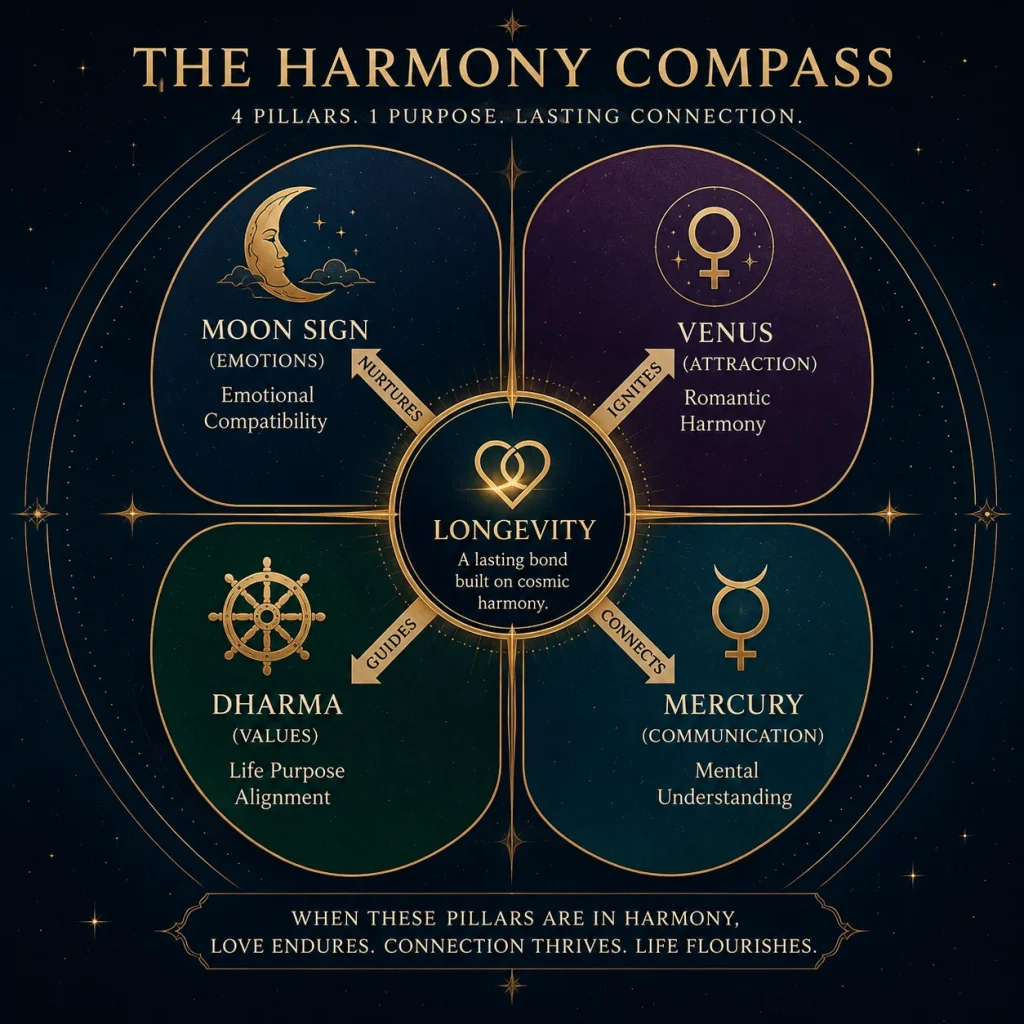
| Relationship Factor | Vedic Concept | Impact on Longevity |
| Mental Harmony | Moon Sign Compatibility | Determines how you process stress together. |
| Physical Attraction | Venus Placement | Influences passion and shared creative joy. |
| Value System | Dharma/Artha | Defines if you share common life goals. |
| Communication | Mercury/3rd House | Vital for resolving everyday conflicts. |
This table illustrates that longevity isn’t just one factor; it is the sum of various celestial alignments working in tandem. A relationship with a high Guna Milan score might struggle if there is a fundamental clash in communication styles, proving that compatibility is a layered experience.
Navigating the Influence of Planetary Transits
The sky is constantly changing. As planets move through the zodiac, they enter into new relationships with our natal charts. These transits can bring unexpected challenges or periods of immense growth. For a couple, a difficult transit for one partner can inadvertently place a strain on the relationship. A seasoned practitioner looks at these periods not as unavoidable fates, but as phases. Just as the seasons change, so do the moods and challenges we face in our relationships.
Recognizing these cycles is one of the most practical applications of Vedic astrology. It teaches us that turbulence is often temporary. When a couple understands that they are in a period governed by a particular planetary transit, they can stop taking the stress out on each other. Instead, they can look at the “weather” of their relationship and decide how best to navigate it. It encourages a proactive rather than reactive stance, which is essential for any long-term union.
The Role of Conscious Effort: The Relationship Matrix
To visualize how relationships evolve, we can use the “Relationship Development Matrix.” This helps couples identify where they are investing their energy and where they might be neglecting the foundation.
The Relationship Development Matrix (Visual Concept)
- Quadrant 1: High Synergy, High Growth – Both partners are aligned and actively learning together.
- Quadrant 2: High Synergy, Low Growth – The relationship is easy but stagnant; needs new challenges.
- Quadrant 3: Low Synergy, High Growth – High conflict but high learning; often leads to intense transformation.
- Quadrant 4: Low Synergy, Low Growth – The most difficult phase; requires a re-evaluation of core values.
Understanding where you sit in this matrix allows you to change your trajectory. Astrology shows us where we are, but it does not dictate where we must stay. By using available digital tools, including a reliable astrology app free of charge, you can track these shifts alongside the expert insights provided at astroma.co to ensure you stay aligned with your path. When each partner is focused on their own personal growth, the relationship naturally thrives. Longevity becomes a byproduct of two people who are constantly evolving and choosing to support each other’s evolution.
Understanding the Role of Free Will
One of the most common misconceptions is that astrology dictates a path that cannot be changed. This is where the “honest exploration” becomes vital. The charts show us the tendencies and the probable outcomes based on current trajectories. However, Vedic philosophy strongly emphasizes Karma and the power of human choice. Astrology provides the map, but you are the driver. You decide the speed at which you travel and the detours you take.
A successful, long-term relationship is an active choice made every single day. Astrology provides the data, but your actions provide the result. If a chart indicates a potential for communication gaps, the knowledge itself empowers you to prioritize open, honest dialogue. If it suggests a difference in emotional needs, you can work on finding a compromise that honors both individuals. The charts do not limit you; they provide the insight necessary to transcend potential limitations.
Building Foundations Through Self-Awareness
The most successful couples are those who have mastered the art of self-awareness. When you know your own strengths, weaknesses, and emotional triggers, you become a much better partner. Vedic astrology serves as a profound tool for this personal development. When you review your chart, you gain clarity on why you respond to certain situations the way you do. This prevents you from projecting your own insecurities onto your partner.
True longevity requires a shift from “me” to “we.” Astrology helps facilitate this by revealing the hidden depths of your partner’s nature. When you understand the planetary influences driving their behavior, it is much easier to hold space for them during difficult times. You begin to see their actions not as personal slights, but as expressions of their unique karmic path.
The Verdict on Prediction
Can Vedic astrology predict the length of a relationship? Perhaps it is more accurate to say that it predicts the quality of the journey. It does not offer a timeline for a breakup or a guarantee of a golden anniversary. Instead, it offers a deep, nuanced understanding of the dynamics at play. It highlights the work that needs to be done and celebrates the natural synergies that make the connection unique.
Ultimately, the longevity of a relationship is determined by the commitment to growth, the ability to forgive, and the shared vision for the future. Vedic astrology is a companion in this process, offering guidance when the path seems unclear. It provides a deeper context to the story you are writing together. Whether your stars indicate an easy path or a challenging one, the power to make the relationship lasting resides entirely in your hands and the conscious, loving decisions you make together every day. By embracing both the wisdom of the stars and the reality of your daily choices, you build a foundation that is as enduring as the cosmos itself.
Frequently Asked Questions
Does a low compatibility score mean a relationship will fail? No. Compatibility scores highlight areas that may require extra effort, but they do not dictate the final outcome of a partnership or determine its success.
How do planetary transits affect long-term couples? Transits represent shifting life cycles. They often explain temporary periods of tension or growth, helping couples understand that challenges are often seasonal.
Is it possible to change the path shown in a birth chart? Yes. Birth charts show tendencies and potential patterns, but personal choices, daily actions, and conscious communication have the power to reshape any outcome.
What is the main goal of using astrology in a relationship? The primary goal is to gain self-awareness and deeper empathy for a partner, which helps in navigating conflicts and strengthening the bond over time.
