
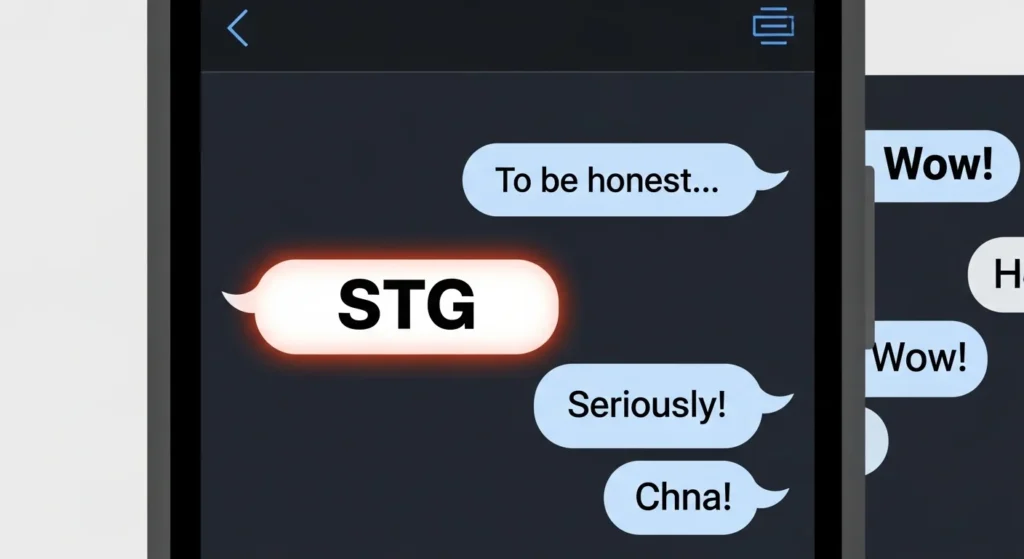

STG (text slang) means “Swear To God.” It is used to emphasize honesty, seriousness, or strong emotion in a statement, often to show that someone is telling the truth or feels strongly about something.
The internet is full of abbreviations that make texting faster and more expressive.
“STG” is one of those short forms you’ve probably seen in chats, comments, or social media posts.
People use it in sentences like “I didn’t do it, STG” or “STG that was the best food ever.”
But what does it really mean in different situations?
And how can you use it naturally without sounding forced?
Let’s break down STG meaning in text in a simple and practical way.
What Does STG Mean in Text? (Simple Explanation)
At its core, STG is used to show seriousness.
It adds emphasis to what someone is saying.
Main Meaning of STG
- Swear To God
- Used to prove honesty
- Shows strong emotion
- Adds emphasis to statements
Unlike some slang, STG has one clear meaning.
However, the tone can change depending on context.
Origin of STG Slang
The phrase “swear to God” has existed for a long time.
It was commonly used in spoken language before texting became popular.
Where It Started
- Everyday spoken English
- Informal conversations
- Expressions of honesty or seriousness
How It Evolved
As texting and social media grew, people shortened phrases.
“Swear to God” became STG for quick typing.
Now it is widely used in chats, memes, and online posts.
Why STG Is So Popular in Texting
There are several reasons for its popularity.
It is simple, expressive, and easy to use.
Key Reasons
- Saves time while typing
- Adds emotional emphasis
- Common in casual conversations
- Works across many platforms
Because of this, STG became a quick way to show sincerity or intensity.
How STG Is Used in Real Life (Chat & Social Media)
You will mostly see STG in informal messages.
It appears in texting, DMs, and comments.
Common Situations
- Defending yourself
- Emphasizing truth
- Expressing strong feelings
- Reacting to surprising situations
Tone and Context: What Does STG Feel Like?
The tone of STG depends on how it is used.
It can feel serious, emotional, or casual.
1. Serious / Honest Tone
Used to prove truth.
“I didn’t take your phone, STG.”
2. Emotional Tone
Used when expressing strong feelings.
“STG I was so scared.”
3. Excited Tone
Used to emphasize excitement.
“STG that movie was amazing.”
4. Defensive Tone
Used to defend yourself.
“STG it wasn’t my fault.”
Labeled Examples of STG Usage
| Context | Example Sentence | Meaning |
|---|---|---|
| Honesty | “I didn’t lie, STG.” | Proving truth |
| Emotion | “STG I was nervous.” | Strong feeling |
| Excitement | “STG that food was great.” | Emphasis |
| Defense | “STG I didn’t do it.” | Justifying yourself |
| Chat message | “STG?” | Asking for confirmation |
STG in Different Online Situations
1. Text Messaging
In texting, STG is very common.
It is used to add emphasis quickly.
- Personal chats
- Group conversations
- Quick replies
2. Social Media
On social media, STG is used in captions and comments.
It helps express reactions.
- Instagram comments
- TikTok captions
- Twitter posts
3. Casual Conversations
Among friends, it feels natural.
It is rarely used in formal situations.
- Friendly chats
- Emotional discussions
Comparison: STG vs Similar Text Slang
Understanding similar terms helps you use STG correctly.
STG vs ISTG
| STG | ISTG |
|---|---|
| Swear To God | I Swear To God |
| General emphasis | More personal emphasis |
FR vs STG
| STG | FR |
|---|---|
| Shows seriousness | Means “for real” |
| Stronger emphasis | Lighter tone |
STG vs ONG
| STG | ONG |
|---|---|
| Swear To God | On God |
| More common | Trendier variation |
Alternate Meanings of STG
While STG usually means “Swear To God,” it can have other meanings in rare contexts.
- Scientific Technical Group
- Setting (in technical discussions)
However, these meanings are uncommon in texting.
Most of the time, it refers to the slang meaning.
Polite or Professional Alternatives to STG
Slang like STG is not suitable for formal communication.
It is better to use clearer language.
Instead, Use:
- I assure you
- I promise
- Honestly
- I am serious
- I guarantee
Example:
Instead of: “I didn’t do it, STG”
Say: “I assure you I didn’t do it.”
Do’s and Don’ts of Using STG
Do
- Use it in casual chats
- Use it to emphasize honesty
- Keep it natural
Don’t
- Use it in professional writing
- Overuse it
- Use it in sensitive situations
Frequently Asked Questions (FAQ)
1. What does STG mean in text?
STG means “Swear To God.”
It is used to emphasize truth or strong feelings.
2. What does STG mean on Snapchat?
It has the same meaning.
It is used to show seriousness or honesty.
3. Is STG rude?
No, it is not rude.
However, it can sound intense depending on context.
4. What does “I STG” mean?
It means “I swear to God.”
It shows strong emphasis.
5. Is STG the same as OMG?
No, they are different.
OMG expresses surprise, while STG shows seriousness.
6. Can STG be used jokingly?
Yes, sometimes.
People use it casually among friends.
7. Is STG common in texting?
Yes, it is widely used.
Especially among younger users.
8. Should I use STG in professional settings?
No, it is better to avoid it.
Use formal phrases instead.
Why STG Matters in Digital Communication
Online communication is fast and expressive.
Short forms like STG help convey emotions quickly.
It also adds personality to messages.
People use it to sound more real and direct.
Conclusion: Key Takeaways About STG Meaning in Text
- STG means Swear To God
- It is used to show honesty or strong emotion
- Common in texting and social media
- Tone can be serious, emotional, or casual
- Not suitable for formal communication
In simple terms, STG adds emphasis to what you say.
Using it correctly helps your messages feel more natural and expressive.