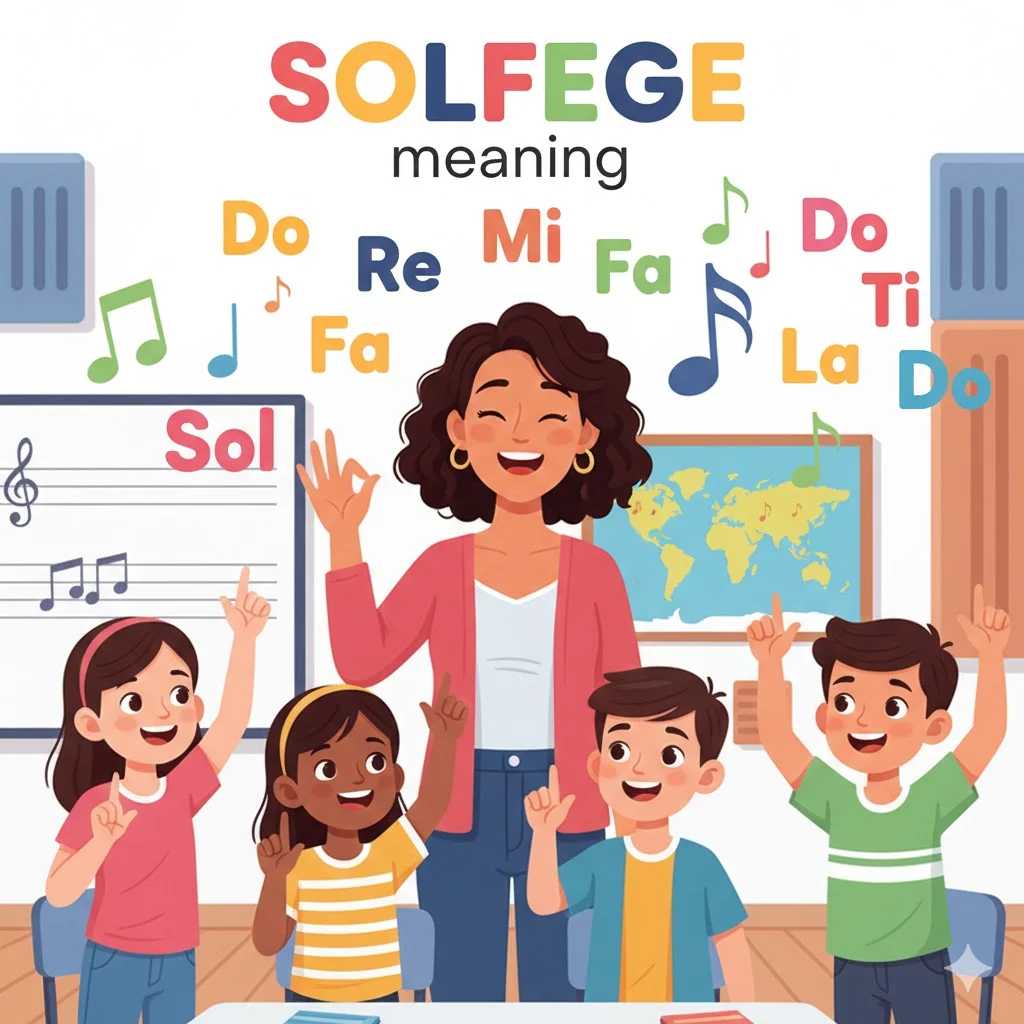

Solfege is a music education system that uses syllables—do, re, mi, fa, sol, la, ti—to represent the notes of a musical scale.
It is designed to teach pitch recognition, sight-singing, and ear training, making it easier for musicians to read and perform music accurately.
Solfege is one of the fundamental tools in music education, helping singers and musicians understand pitch, scales, and melody. Whether you are a beginner in music or an experienced performer, understanding solfege can dramatically improve your musical skills.
Today, solfege is taught globally in schools, conservatories, and online music programs. It is a method that transcends language and culture, offering a universal approach to learning and internalizing musical notes.
Although solfege is often associated with singing, its impact extends beyond vocal training. Musicians use it to internalize melodies, understand harmony, and develop a strong musical ear. In this guide, you’ll discover solfege’s meaning, history, usage, examples, comparisons, and tips for learning, along with answers to common questions.
What Does Solfege Really Mean? (Beyond the Literal Definition)
At its core, solfege is a musical language. While its literal meaning relates to naming musical notes, it serves a broader purpose in training the ear and mind to perceive music accurately.
Breaking Down the Concept
The term solfege comes from the Italian words:
- Sol – the note G in a scale
- Fa – the note F in a scale
It refers to the system of assigning syllables to each note in a scale:
- Do, Re, Mi, Fa, Sol, La, Ti (or Si)
By singing these syllables, students can internalize pitches and intervals, making it easier to sight-read, harmonize, and compose music.
Practical interpretation:
Solfege trains both the ear and the voice, building a musician’s ability to recognize, sing, and understand musical structures.
Origin of Solfege
Historical Roots
Solfege originated in Europe during the medieval period. Guido of Arezzo, an Italian music theorist from the 11th century, is credited with formalizing a precursor to modern solfege. His system made it easier to teach Gregorian chants to choirs.
Cultural Significance
Over centuries, solfege evolved into different systems, including:
- Fixed Do: Do always represents C
- Movable Do: Do represents the tonic of the current key
This flexibility allows solfege to adapt to various musical traditions, from classical Western music to contemporary compositions.
Why Solfege Is Popular Worldwide
Solfege remains a cornerstone of music education due to its effectiveness in training musicians’ ears and voices.
Key Benefits
- 🎵 Enhances pitch recognition and sight-singing
- 🧠 Improves musical memory and improvisation skills
- 🎤 Strengthens vocal control and intonation
- 🌎 Provides a universal framework for teaching music across cultures
As a result, solfege is taught in schools, conservatories, and private music lessons around the world.
How Solfege Is Used in Practice
Musicians use solfege in multiple ways, depending on their skill level and context.
Common Applications
- Sight-singing and vocal exercises
- Ear training for melody and harmony recognition
- Teaching children and beginners musical fundamentals
- Composing and arranging music
- Learning complex classical or jazz pieces
For example, when a teacher says “sing the major scale using solfege”, students would sing: Do, Re, Mi, Fa, Sol, La, Ti, Do.
Tone and Context: How Solfege Feels
Although solfege is inherently technical, it can evoke different experiences depending on teaching methods.
1. Friendly / Educational Tone
Teachers introduce it as a fun, interactive way to learn notes.
“Let’s sing the scale together: Do, Re, Mi! 🎶”
2. Neutral / Professional Tone
Used in music schools and exams.
“Please demonstrate the solfege of this melody accurately.”
3. Challenging / Focused Tone
In advanced practice, solfege can become a rigorous training exercise.
“Transcribe the melody using movable Do solfege for precision.”
Labeled Examples of Solfege Usage
| Context | Example Sentence | Purpose / Tone |
|---|---|---|
| Beginner class | “Sing the C major scale: Do, Re, Mi, Fa, Sol, La, Ti, Do.” | Educational / Friendly |
| Vocal training | “Use solfege to practice pitch accuracy.” | Neutral / Professional |
| Ear training | “Identify intervals by singing with solfege.” | Focused / Technical |
| Sight-reading | “Follow the sheet music using solfege.” | Skill-building |
| Composition | “Map the melody in solfege before notation.” | Creative / Analytical |
Solfege in Music Education
Solfege plays a crucial role in developing musicianship.
Why Teachers Rely on Solfege
- Encourages independent sight-reading
- Develops strong pitch memory
- Makes learning scales and intervals intuitive
- Supports improvisation and transposition
As a result, solfege is considered an essential foundation for both classical and contemporary musicians.
Comparison: Solfege vs Other Musical Systems
Solfege vs Letter Names
| Solfege | Letter Names |
|---|---|
| Uses syllables: Do, Re, Mi | Uses letters: C, D, E |
| Emphasizes relative pitch | Focuses on absolute pitch |
| Facilitates sight-singing | Facilitates notation reading |
Solfege vs Tonic Solfa
| Solfege | Tonic Solfa |
|---|---|
| Includes fixed and movable Do systems | Primarily movable Do |
| Widely used internationally | Popular in UK and Commonwealth countries |
Solfege vs Numerical Notation
| Solfege | Number Notation |
|---|---|
| Do = 1, Re = 2 (in some systems) | Uses numbers exclusively |
| Easier for vocal practice | Often for instrument learning |
Alternate Meanings of Solfege
While solfege generally refers to the system of musical syllables, some contexts include:
- Ear training exercise: Singing intervals or melodies
- Notation aid: Mapping compositions before sheet music
- Pedagogical method: Teaching rhythm and pitch to beginners
Despite these variations, the core principle remains teaching musical pitch through syllables.
Professional Alternatives and Complementary Methods
In formal music training, solfege may be combined with or replaced by:
Alternatives
- Letter notation – C, D, E, etc.
- Number notation – 1, 2, 3 for scale degrees
- Kodály method – Focuses on rhythm and movement
- Curwen hand signs – Gesture-based solfege
Complementary Tools
- Piano or keyboard exercises
- Interval drills
- Ear training software or apps
Do’s and Don’ts of Using Solfege
Do
- Practice consistently
- Pair solfege with instruments or hand signs for reinforcement
- Use movable or fixed Do depending on context
Don’t
- Skip exercises—it weakens pitch memory
- Confuse solfege syllables with note names arbitrarily
- Rely solely on solfege without ear training or practice
Frequently Asked Questions (FAQ)
1. What is the exact meaning of solfege?
Solfege is a system of using syllables like Do, Re, Mi to represent musical notes and train pitch recognition.
2. Who invented solfege?
Guido of Arezzo, an 11th-century Italian theorist, formalized early methods for teaching musical notation that evolved into modern solfege.
3. Is solfege only for singers?
No. Instrumentalists use it for ear training, sight-reading, and improvisation as well.
4. What is the difference between fixed Do and movable Do?
Fixed Do always maps Do to the note C, whereas movable Do assigns Do to the tonic of the key being used.
5. Can solfege improve musical memory?
Absolutely. It helps internalize scales, melodies, and intervals.
6. Is solfege used in schools?
Yes, it is a core part of music education worldwide, from beginner classes to conservatories.
7. How do you practice solfege at home?
Sing scales, sight-read melodies, and practice intervals using either fixed or movable Do systems.
8. Is solfege only Western music?
While it originated in Western music, its principles are applied globally, including in jazz, pop, and fusion genres.
Why Solfege Still Matters Today
In today’s musical landscape, solfege is more than tradition—it is a tool for precision, creativity, and confidence. By learning solfege, musicians develop a stronger ear, faster sight-reading skills, and a deeper understanding of musical structure.
Conclusion: Key Takeaways About Solfege Meaning
- Solfege represents the syllables Do, Re, Mi, Fa, Sol, La, Ti, mapping musical pitches
- It has historical roots in medieval Europe, formalized by Guido of Arezzo
- The system enhances ear training, sight-singing, and pitch accuracy
- It adapts to fixed Do, movable Do, or hand-sign methods
- Mindful practice ensures musical skill development and confidence
Ultimately, solfege is a universal language for music that bridges learning, performance, and creativity.