
POV stands for “Point of View.”
It refers to the perspective from which a story, video, or statement is presented. In digital media, it often describes who is narrating or how the audience should perceive a situation.
POV has become one of the most popular terms in digital communication today. From social media posts to storytelling in movies and online videos, you might have seen it used frequently—but what does it actually mean? Understanding POV can enhance your comprehension of digital trends, writing techniques, and conversational shorthand.
Although POV is commonly used in social media and entertainment today, it also has historical roots in literature and storytelling. This guide will explore the meaning, origins, popular usage, examples, variations, and even professional alternatives, ensuring you know how to use it correctly in multiple contexts.
What Does POV Really Mean?
At its core, POV is about perspective. It determines whose eyes or whose thoughts we experience in a story, conversation, or video.
Literary Definition
In literature, POV refers to the narrator’s position in relation to the story:
- First-person POV: “I walked into the room and felt nervous.”
- Second-person POV: “You walk into the room and feel nervous.”
- Third-person POV: “She walked into the room, feeling nervous.”
Digital Media Definition
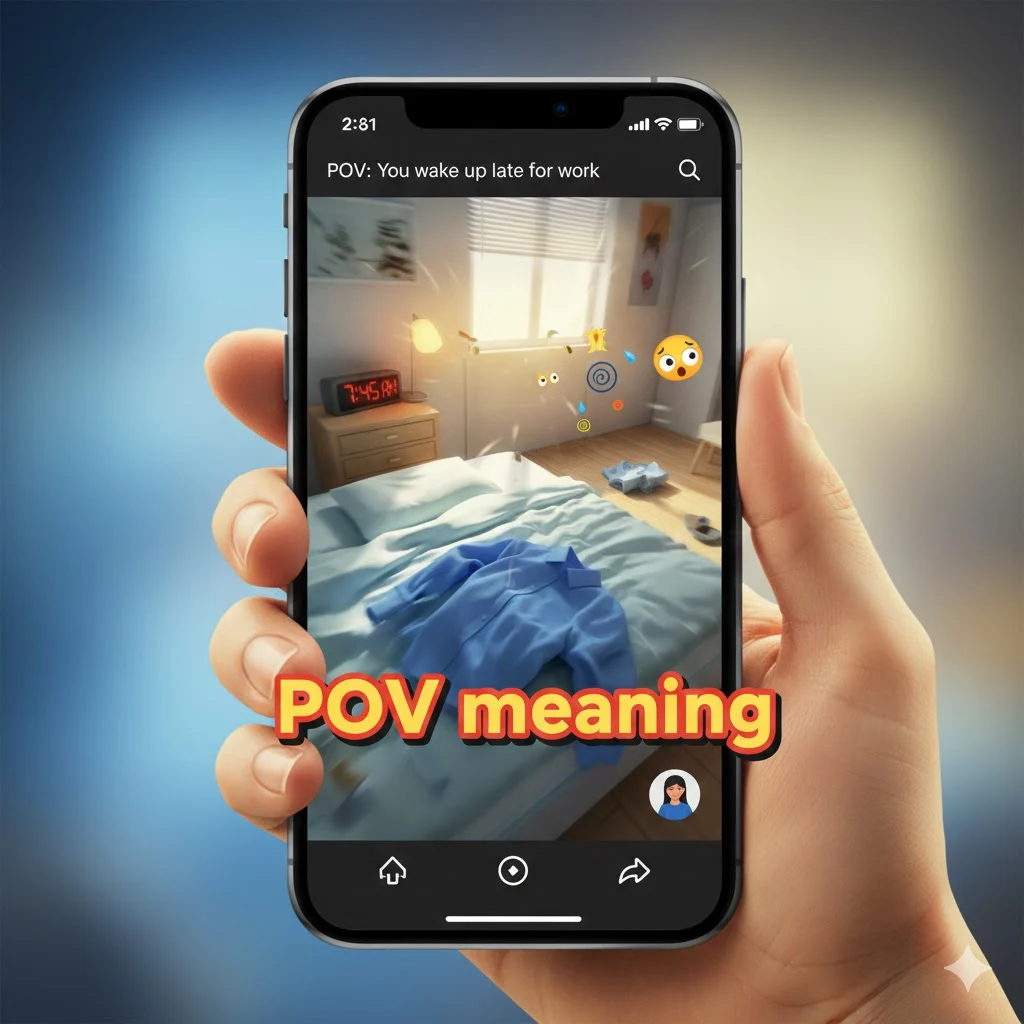
On platforms like TikTok, Instagram, and Twitter, POV often sets the scene:
“POV: You just realize it’s Monday tomorrow 😱”
In this case, the viewer adopts the scenario’s perspective for comedic, dramatic, or relatable effect.
Origin of POV
Literary Roots
POV originates from storytelling and literary theory, where it was used to classify narrators and perspectives. Authors like Jane Austen and Charles Dickens relied on POV to shape reader experience.
Digital Evolution
With the rise of social media and short-form video, POV transformed into a shorthand for:
- Perspective-based content
- Role-playing scenarios
- Relatable or immersive storytelling
Consequently, POV evolved from a literary term to a cultural phenomenon online.
Why POV Is So Popular Today
POV’s global popularity can be attributed to several factors:
- 🎥 Short-form video trends encourage immersive storytelling
- 📱 Memes and relatable content often rely on perspective-based humor
- ✍️ Writers and content creators adopt it for engaging narratives
- 🤝 Viewers enjoy stepping into someone else’s shoes virtually
Moreover, POV allows creators to communicate empathy, humor, or drama in just a few words or seconds.
How POV Is Used in Real Life
POV is versatile, appearing in both casual and professional contexts.
Common Situations
- Social media captions and hashtags
- Short videos or TikTok challenges
- Storytelling in blogs, books, and scripts
- Gaming content and live streams
- Online discussions describing someone’s experience
In every case, POV emphasizes “how the situation is being seen or experienced.”
Tone and Context: Understanding POV
POV can carry different tones depending on usage:
1. Humorous / Light Tone
Often used in relatable memes or jokes.
“POV: You open the fridge and it’s empty again 😅”
2. Dramatic / Emotional Tone
Used to create empathy or tension.
“POV: You’re saying goodbye to your best friend for the last time 😢”
3. Neutral / Informative Tone
Common in educational, gaming, or professional content.
“POV refers to the perspective from which the camera or narrator tells a story.”
4. Sarcastic / Ironic Tone
Sometimes used ironically in memes or commentary.
“POV: You’re the teacher who just realized it’s Friday and no one did homework 😏”
Labeled Examples of POV Usage
| Context | Example Sentence | Tone |
|---|---|---|
| Social media meme | “POV: You just dropped your phone on your face in bed” | Humorous |
| TikTok video | “POV: You walk into the wrong Zoom meeting” | Relatable |
| Literature | “First-person POV shows the narrator’s inner thoughts.” | Informative |
| Gaming | “POV: You’re about to win the last round” | Exciting |
| Storytelling | “POV: You realize your childhood friend moved away” | Emotional |
POV in Digital Media
In digital content, POV is often both a tool and a trend. Creators use POV to:
- Make videos immersive
- Encourage viewers to relate to a scenario
- Communicate humor, drama, or emotion efficiently
Additionally, POV challenges often go viral because they allow viewers to step into another person’s perspective instantly.
Comparison: POV vs Similar Terms
POV vs Perspective
| POV | Perspective |
|---|---|
| Focused on narrator or viewpoint | Broader interpretation of situation |
| Commonly used in storytelling or media | Used in analysis, discussion, or opinion |
| Often shorthand in digital content | Formal term in writing |
POV vs Point of Reference
| POV | Point of Reference |
|---|---|
| Narrative or visual angle | Basis for comparison or context |
| Engages audience experience | Analytical or informational focus |
| Common in creative work | Common in technical or academic work |
POV vs First-Person / Third-Person
| POV | First/Third Person |
|---|---|
| Describes the general viewpoint | Specifies the grammatical or narrative lens |
| Digital shorthand for immersive content | Literary technique |
| Flexible and casual | Structured and formal |
Alternate Meanings of POV
Besides its narrative and digital meaning, POV can occasionally appear in:
- Military / Technical contexts: “Point of View” can refer to a strategic vantage or camera angle in simulations
- Photography / Filmmaking: Describes the camera’s position relative to the subject
- Business / Strategy: Sometimes used to describe perspective in reports or discussions
Despite variations, the core idea always centers on “how something is viewed or experienced.”
Professional and Polite Alternatives to POV
When POV feels too casual, especially in professional settings, consider alternatives:
Formal Alternatives
- Perspective
- Viewpoint
- Standpoint
- Angle
Creative or Digital Alternatives
- Narrative perspective
- Story lens
- Character viewpoint
Do’s and Don’ts of Using POV
Do
- Use POV to enhance storytelling
- Apply it in both digital and literary contexts
- Pair it with clear context to avoid confusion
Don’t
- Overuse it as a hashtag without context
- Confuse it with other technical abbreviations
- Misapply it in formal writing without explanation
Frequently Asked Questions (FAQ)
1. What does POV stand for?
POV stands for Point of View, referring to a perspective in storytelling, video, or conversation.
2. Is POV only used online?
No. While popularized online, it is widely used in literature, film, and other media.
3. What is the difference between POV and perspective?
POV is a specific viewpoint of a narrator or character, while perspective is the broader way of seeing or interpreting a situation.
4. Can POV be first-person or third-person?
Yes. In literature and digital media, POV can adopt first-person, second-person, or third-person viewpoints.
5. Is POV slang?
It is informal and commonly used online, but it originated as a formal literary term.
6. How do I use POV in social media?
Add POV at the start of your caption or video description to indicate the viewer’s perspective.
7. Can POV be professional?
Yes, using terms like perspective, viewpoint, or narrative perspective is more formal in professional settings.
8. Why is POV important in storytelling?
It shapes how the audience experiences a narrative and influences engagement, empathy, and clarity.
Why POV Matters Today
In a world dominated by short-form content, social media trends, and immersive storytelling, POV helps audiences step into someone else’s shoes. As a result, it encourages engagement, relatability, and creativity, making it indispensable for writers, creators, and digital communicators.
Conclusion: Key Takeaways About POV Meaning
- POV means “Point of View” and highlights perspective
- It is used in literature, digital media, social platforms, and filmmaking
- POV can be humorous, emotional, dramatic, or informative depending on context
- Proper understanding enhances storytelling, relatability, and engagement
- Mindful use ensures clarity and effectiveness in communication
Ultimately, POV is more than a term—it is a lens through which we experience stories and content.