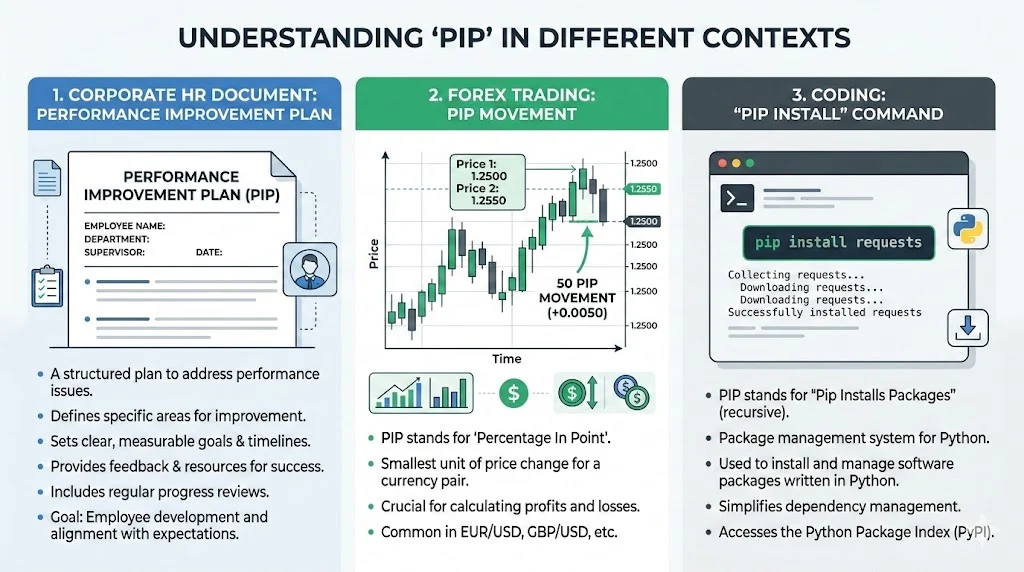

PIP full form depends on context. The most common meanings include:
- Performance Improvement Plan (Human Resources)
- Percentage in Point (Forex trading)
- Preferred Installer Program (Business/Construction)
- Pip (Package Installer for Python) (Software Development)
In short, PIP is an abbreviation with multiple definitions across industries.
Have you ever seen “PIP” in a job email, a trading forum, or a tech discussion and wondered what it actually means? You’re not alone. The abbreviation PIP appears in multiple industries—and interestingly, it doesn’t mean the same thing everywhere.
From corporate HR departments to forex trading platforms and software development environments, PIP carries very different meanings depending on context. Therefore, understanding the full form of PIP requires looking at the situation in which it’s used.
Because the term appears in professional, financial, and technical conversations, let’s break down each meaning clearly and explore how it’s used in real life.
PIP Full Form in HR: Performance Improvement Plan
In corporate settings, PIP most commonly stands for Performance Improvement Plan.
What Is a Performance Improvement Plan?
A Performance Improvement Plan (PIP) is a structured document given to an employee whose performance does not meet company expectations. It outlines:
- Specific performance issues
- Clear improvement goals
- Measurable targets
- A defined timeline
- Possible consequences if goals are not met
Why Companies Use a PIP
Companies introduce a PIP to:
- Provide employees a fair chance to improve
- Document performance concerns
- Set measurable benchmarks
- Maintain transparency in HR processes
Example (Professional Context)
“You’ve been placed on a PIP for the next 60 days to improve sales performance.”
Tone Explanation
- Neutral/Professional: Standard HR procedure
- Serious: Signals performance concerns
- Opportunity-Based: A chance to improve before termination
Although many employees feel anxious upon hearing “PIP,” it can sometimes serve as a structured roadmap for improvement.
PIP Full Form in Forex Trading: Percentage in Point
In the world of foreign exchange trading, PIP stands for Percentage in Point (or sometimes “Price Interest Point”).
What Does a Pip Mean in Trading?
A pip measures the smallest price movement in a currency pair.
For example:
- If EUR/USD moves from 1.1000 to 1.1001 → that’s 1 pip
- If USD/JPY moves from 110.00 to 110.01 → that’s 1 pip
Why Pips Matter
Traders use pips to:
- Measure profit or loss
- Calculate risk
- Analyze price movements
- Compare volatility
Example (Trading Context)
“The trade gained 25 pips before closing.”
Tone Explanation
- Neutral/Technical: Used in financial analysis
- Analytical: Focused on market movement
In trading, a pip is purely numerical and carries no emotional meaning.
PIP in Technology: Pip (Package Installer for Python)
In software development, pip refers to the package installer for Python.
Specifically, it’s the tool programmers use to install and manage Python libraries.
What Does pip Do?
Developers use pip to:
- Install packages (
pip install numpy) - Upgrade libraries
- Remove packages
- Manage project dependencies
Example (Tech Context)
pip install requests
This command installs the “requests” library in Python.
Tone Explanation
- Technical: Used in coding environments
- Instructional: Often appears in documentation
Unlike HR or trading, this version of PIP is entirely technical and tool-based.
Other Possible Full Forms of PIP
Although less common, PIP can also stand for:
- Preferred Installer Program (Business partnerships)
- Personal Independence Payment (UK government benefit)
- Project Implementation Plan (Management)
Because the acronym varies across industries, context always determines its meaning.
Labeled Example Table of PIP Meanings
| Industry | PIP Full Form | Meaning | Tone |
|---|---|---|---|
| HR / Corporate | Performance Improvement Plan | Employee performance monitoring | Serious / Professional |
| Forex Trading | Percentage in Point | Smallest price movement | Technical |
| Software Development | Package Installer for Python | Tool to manage Python packages | Technical |
| Government (UK) | Personal Independence Payment | Disability benefit program | Administrative |
PIP vs Similar Abbreviations
Since PIP appears in professional communication, it’s helpful to compare it with related terms.
PIP vs KPI
| PIP | KPI |
|---|---|
| Performance Improvement Plan | Key Performance Indicator |
| Used when performance is lacking | Used to measure success |
| Reactive measure | Proactive measurement |
PIP vs SIP (HR Context)
| PIP | SIP |
|---|---|
| Performance Improvement Plan | Sales Incentive Plan |
| Focuses on improvement | Focuses on rewards |
| Often corrective | Motivational |
How to Understand PIP Based on Context
To determine what PIP means, ask yourself:
- Are you in a workplace HR discussion? → Likely Performance Improvement Plan
- Are you reading a trading chart? → Probably Percentage in Point
- Are you installing software? → Definitely Python’s pip
Therefore, context is the key to accurate interpretation.
Professional Alternatives or Related Terms
Depending on usage, alternatives may include:
In HR
- Development Plan
- Performance Review
- Coaching Plan
In Trading
- Tick
- Basis Point
Tech
- Package Manager
- Dependency Installer
Each term carries slightly different technical nuances.
Frequently Asked Questions (FAQ)
1. What is the most common full form of PIP?
In corporate environments, PIP most commonly stands for Performance Improvement Plan.
2. Is being put on a PIP a bad sign?
Not necessarily. While it indicates performance concerns, it can also provide a structured opportunity to improve.
3. What does PIP mean in trading?
In forex trading, PIP means Percentage in Point, which measures price movement.
4. What is pip in Python?
In Python, pip is the package installer tool used to install libraries and manage dependencies.
5. How long does a Performance Improvement Plan last?
Typically, a PIP lasts 30 to 90 days, depending on company policy.
6. Is a pip the same as a tick in trading?
Not exactly. A pip measures currency price movement, while a tick refers to the smallest movement in other financial markets.
7. Can PIP lead to termination?
Yes, if performance does not improve within the specified timeframe, termination may occur.
8. Why does PIP have different meanings?
Because it is an acronym, multiple industries use the same letters to represent different phrases.
Why Understanding PIP Matters
Because PIP appears in emails, financial reports, and technical documentation, misunderstanding it can lead to confusion. For example, interpreting a trading “pip” as a workplace “PIP” could completely change the meaning of a conversation.
Therefore, recognizing the context ensures accurate communication and informed decision-making.
Conclusion: Key Takeaways About PIP Full Form
- PIP has multiple meanings across industries
- In HR, it stands for Performance Improvement Plan
- In forex, it means Percentage in Point
- In programming, it refers to the Python package installer
- Context determines the correct interpretation
Ultimately, whenever you encounter the abbreviation PIP, pause and consider the environment. The meaning becomes clear once the setting is understood.