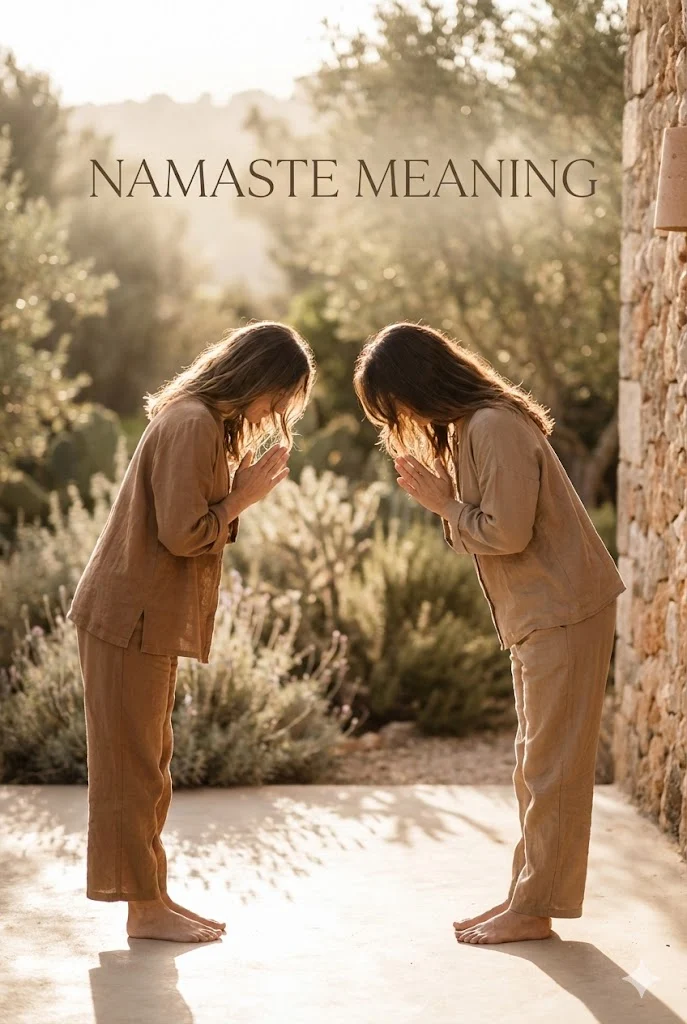

Namaste means “I bow to you” and expresses deep respect, humility, and acknowledgment.
Traditionally, it signifies “The divine within me honors the divine within you,” and is commonly accompanied by a gesture where the palms are pressed together at the heart.
Namaste is far more than a simple greeting. In fact, it represents a blend of language, gesture, philosophy, and cultural respect that has traveled across continents. From ancient temples to modern yoga studios, namaste continues to symbolize humility, mindfulness, and human connection.
As global interest in wellness, mindfulness, and cultural awareness grows, many people naturally ask: What does namaste really mean? To answer that, we must explore not only its definition, but also its origins, tone, usage, and relevance in today’s world.
Although often translated as “hello” or “goodbye,” namaste carries a meaning that reaches far beyond casual conversation. Throughout this guide, you’ll discover where the word comes from, how it’s used in real life, and why it still matters today.
What Does Namaste Really Mean? (Beyond the Literal Translation)
At first glance, namaste appears to be a polite greeting. However, its emotional and spiritual depth sets it apart from everyday expressions.
Breaking Down the Word
The word namaste originates from Sanskrit and consists of three components:
- Namaḥ (नमः) – bow, reverence, or respect
- Te (ते) – to you
- Aste (अस्ते) – I offer or I place
Literal meaning: “I bow to you.”
Deeper interpretation:
“I honor and acknowledge the divine presence within you.”
As a result, namaste becomes not just a word, but a meaningful exchange of mutual respect.
Origin of Namaste
Sanskrit Roots
Namaste has its roots in Sanskrit, one of the oldest known languages in human history. Notably, it appears in ancient Hindu scriptures such as the Vedas and Upanishads, where humility and reverence are central themes.
Cultural Background
Historically, namaste has been widely used in:
- India
- Nepal
- Bhutan
- Parts of Sri Lanka
- Regions of Southeast Asia
Because of this long-standing tradition, namaste became deeply intertwined with Hindu, Buddhist, and Jain cultural practices.
Why Is Namaste So Popular Worldwide?
In recent decades, namaste has gained global recognition. This widespread popularity did not happen by accident.
Key Reasons for Its Global Rise
- 🌍 Expansion of yoga and meditation practices worldwide
- 🧘 Growing influence of Indian philosophy and wellness culture
- 🤝 Preference for non-contact greetings, especially after global health concerns
- 🌱 Increased focus on mindfulness, empathy, and inner peace
Consequently, namaste is now embraced across cultures, languages, and belief systems.
How Namaste Is Used in Real Life
Namaste adapts easily to different social settings. Depending on context, it can feel formal, warm, spiritual, or professional.
Common Situations Where Namaste Is Used
- Greeting elders or respected individuals
- Welcoming guests into a home or event
- Opening or closing yoga and meditation sessions
- Expressing gratitude or humility
- Participating in spiritual or cultural ceremonies
Because of its flexibility, namaste remains relevant in both traditional and modern environments.
The Namaste Gesture (Anjali Mudra)
In addition to the spoken word, namaste is traditionally paired with a physical gesture known as Anjali Mudra.
How to Perform the Gesture Correctly
- Bring your palms together
- Place them at chest level, near the heart
- Gently bow your head
- Maintain calm awareness or soft eye contact
Together, the gesture and the word reinforce sincerity and respect.
Tone and Context: What Does Namaste Feel Like?
The meaning of namaste can subtly change depending on tone, expression, and setting.
1. Friendly and Warm Tone
Used among friends, family members, or familiar guests.
“Namaste! It’s so good to see you 😊”
2. Neutral and Respectful Tone
Common in formal meetings or professional environments.
“Namaste, everyone. Thank you for joining us.”
3. Spiritual or Reverent Tone
Frequently heard in yoga classes, meditation sessions, or prayer.
“Namaste 🙏 May peace guide your journey.”
4. Dismissive or Ironic Tone (Rare)
Occasionally used humorously or sarcastically in modern speech.
“Namaste… and that’s all.” 😐
(This usage is uncommon and heavily context-dependent.)
Labeled Examples of Namaste Usage
| Context | Example Sentence | Tone |
|---|---|---|
| Greeting elders | “Namaste, Uncle.” | Respectful |
| Yoga class | “Thank you for practicing today. Namaste.” | Calm & spiritual |
| Formal event | “Namaste and welcome to our conference.” | Professional |
| Casual meeting | “Namaste! Long time no see.” | Friendly |
| Spiritual farewell | “Namaste 🙏 Until we meet again.” | Mindful |
Namaste in Yoga and Spiritual Practice
Within yoga philosophy, namaste carries profound significance.
Why Yoga Teachers Say Namaste
- To acknowledge collective effort
- To express gratitude toward students
- To recognize shared energy and intention
Therefore, in yoga, namaste becomes a closing ritual rooted in awareness and connection.
Comparison: Namaste vs Similar Greetings
Namaste vs Hello
| Namaste | Hello |
|---|---|
| Spiritual and respectful | Casual and neutral |
| Deep cultural meaning | General greeting |
| Often paired with a gesture | Mostly verbal |
Namaste vs Salaam
| Namaste | Salaam |
|---|---|
| Sanskrit origin | Arabic origin |
| “I bow to you” | “Peace be upon you” |
| Hindu/Buddhist roots | Islamic tradition |
Namaste vs Pranam
| Namaste | Pranam |
|---|---|
| Common everyday greeting | More formal |
| Used across age groups | Often used for elders |
| Hands together | May include touching feet |
Alternate Meanings of Namaste
Although the core meaning remains consistent, namaste can express different intentions depending on context:
- Greeting: Hello
- Farewell: Goodbye
- Gratitude: Thank you
- Spiritual acknowledgment: Mutual respect
Regardless of usage, respect remains the central theme.
Professional and Polite Alternatives to Namaste
In some situations, alternative expressions may feel more appropriate.
Formal Alternatives
- Greetings
- Welcome
- Good morning / Good evening
Mindful or Spiritual Alternatives
- Peace be with you
- With gratitude
- In light and love
Cultural Alternatives
- Salaam
- Sat Sri Akal
- Vanakkam
Do’s and Don’ts of Using Namaste
Do
- Use the word sincerely
- Understand the cultural context
- Pair it with the appropriate gesture
Don’t
- Use it sarcastically
- Reduce it to a trend or buzzword
- Overuse it in casual slang
Frequently Asked Questions (FAQ)
1. What is the true meaning of namaste?
Namaste means “I bow to you” and symbolizes respect, humility, and shared humanity.
2. Is namaste a religious word?
While it has spiritual roots, namaste is widely used as a cultural greeting beyond religion.
3. Can namaste be used for hello and goodbye?
Yes, namaste works naturally as both a greeting and a farewell.
4. Is namaste only used in yoga?
No. Yoga popularized it globally, but it has been used in daily life for centuries.
5. How should someone respond to namaste?
Typically, one responds by saying namaste back with the same gesture.
6. Is it appropriate for non-Indians to say namaste?
Absolutely—when used respectfully, it is generally welcomed.
7. What’s the difference between namaste and namaskar?
Namaskar is slightly more formal, though both convey similar respect.
8. Is namaste formal or informal?
It can be either, depending on tone, setting, and intention.
Why Namaste Still Matters Today
In an increasingly fast-paced world, namaste offers a moment of pause. More importantly, it encourages acknowledgment, humility, and human connection—values that remain timeless.
Conclusion: Key Takeaways About Namaste Meaning
- Namaste means “I bow to you” and conveys deep respect
- It has ancient roots in Sanskrit and South Asian culture
- The word is widely used in daily greetings, yoga, and spiritual settings
- Its tone may be friendly, professional, or reverent
- Mindful usage ensures authenticity and cultural respect
Ultimately, namaste is not just spoken—it is felt.