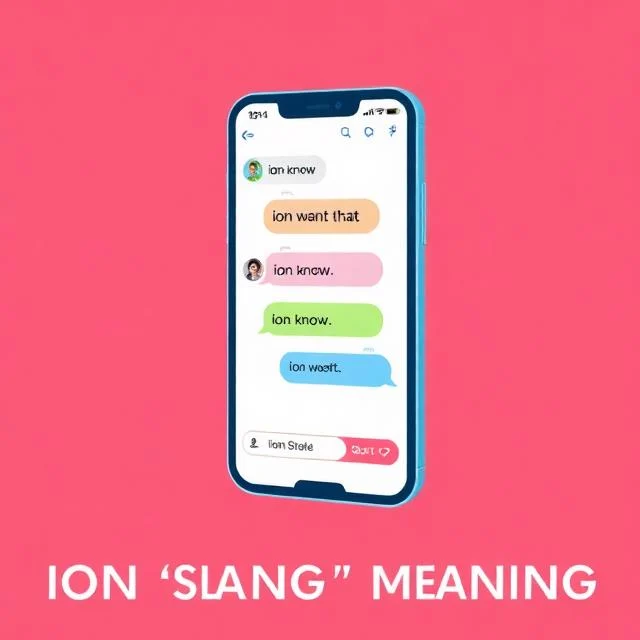

Ion (slang) means “I don’t.” It’s a casual, shortened way of saying “I don’t,” commonly used in texting and social media conversations.
The internet is full of shortened phrases.
“Ion” is one of those slang terms that can confuse you at first glance.
You might see messages like “ion like that” or “ion know him” and wonder what’s going on.
At first, it looks like a science word.
But in slang, it has a completely different meaning.
Let’s break down the meaning of ion slang in a simple and practical way.
What Does Ion Mean in Slang? (Simple Explanation)
At its core, ion is just a shortened version of a common phrase.
It replaces two words with one.
Main Meaning of Ion
- “I don’t”
- Used in casual typing
- Common in texting and social media
- Reflects fast, informal speech
People use ion because it’s quicker to type.
It also matches how some people pronounce “I don’t” in fast speech.
Origin of Ion Slang
The slang term ion didn’t come from science.
It developed from spoken language patterns.
Where It Started
- African American Vernacular English (AAVE)
- Casual spoken English
- Online chat and texting culture
How It Spread
As texting became more popular, people shortened phrases.
Social media platforms helped it spread quickly.
Apps like TikTok and Twitter made it even more common.
Now, ion is widely used in casual digital conversations.
Why Ion Is So Popular Online
There are simple reasons behind its popularity.
It fits perfectly into fast communication.
Key Reasons
📱 Faster typing and messaging
💬 Matches natural speech patterns
🔥 Popular in youth and internet culture
⚡ Short, simple, and easy to use
Because of this, ion became a go-to shortcut for “I don’t.”
How Ion Is Used in Real Life (Online & Chat)
You’ll mostly see ion in messages and comments.
It rarely appears in formal writing.
Common Situations
- Texting friends
- Social media captions
- Casual online conversations
- Replies and quick chats
Tone and Context: What Does Ion Feel Like?
The tone of ion is usually relaxed.
It feels informal and conversational.
1. Casual / Friendly Tone
Used in everyday chats.
“Ion wanna go out today ”
2. Neutral Tone
Used in simple statements.
“Ion know the answer.”
3. Dismissive Tone
Used to show disinterest.
“Ion care about that.”
4. Lazy / Quick Reply Tone
Used for fast typing.
“Ion got time.”
Labeled Examples of Ion Usage
| Context | Example Sentence | Meaning |
|---|---|---|
| Text message | “Ion feel like studying” | I don’t feel like studying |
| Social media | “Ion trust him” | I don’t trust him |
| Chat reply | “Ion know” | I don’t know |
| Casual talk | “Ion want that” | I don’t want that |
| Quick response | “Ion got it” | I don’t have it |
Ion in Different Online Communities
1. Social Media Platforms
Here, ion is very common in captions and comments.
It helps keep messages short and natural.
- TikTok comments
- Instagram captions
- Twitter/X posts
2. Texting & Messaging
In chats, ion is used for speed.
It replaces “I don’t” instantly.
- WhatsApp messages
- Messenger chats
- SMS texting
3. Youth & Internet Culture
Younger users use ion more frequently.
It reflects modern slang trends.
- Casual conversations
- Online communities
Comparison: Ion vs Similar Internet Slang
Understanding similar terms helps avoid confusion.
Idk vs Ion
| Ion | Idk |
|---|---|
| Means “I don’t” | Means “I don’t know” |
| Broader usage | Specific meaning |
Ion vs Imma
| Ion | Imma |
|---|---|
| I don’t | I am going to |
| Negative phrase | Future action |
Ion vs Ain’t
| Ion | Ain’t |
|---|---|
| I don’t | Am not / is not / are not |
| More specific | More flexible |
Alternate Meanings of Ion (Outside Slang)
The word ion has other meanings too.
These are not related to slang.
- Science: A charged particle
- Chemistry/Physics term
- Sometimes confused with abbreviations
So always rely on context to understand it correctly.
Polite or Professional Alternatives to Ion
In formal situations, slang should be avoided.
Use complete phrases instead.
Instead, Use:
- I do not
- I don’t
- I am not interested
- I do not know
Example:
Instead of: “Ion know”
Say: “I don’t know.”
Do’s and Don’ts of Using Ion
Do
- Use it in casual chats
- Use it with friends
- Keep it informal
Don’t
- Use it in professional writing
- Use it in academic work
- Assume everyone understands it
Frequently Asked Questions (FAQ)
1. What does ion mean in slang?
Ion means “I don’t.”
It is a shortened version used in texting.
2. What does ion mean in texting?
It simply means I don’t.
For example, “ion know” = “I don’t know.”
3. Is ion proper English?
No, it is slang.
It should not be used in formal writing.
4. Why do people say ion instead of I don’t?
It’s faster and matches how people speak.
It also feels more casual.
5. Is ion related to science?
In slang, no.
In science, it means a charged particle.
6. Can I use ion on social media?
Yes, it’s very common there.
It fits casual communication.
7. Is ion used worldwide?
Yes, especially online.
It’s popular among younger users.
8. Should I use ion professionally?
No, avoid it.
Use full phrases instead.
Why Ion Matters in Today’s Digital World
Online communication is all about speed.
Shortcuts like ion make conversations faster.
They also reflect how language evolves.
Digital culture continues to shape how we write and speak.
Conclusion: Key Takeaways About Ion Meaning in Slang
- Ion means “I don’t”
- Common in texting and social media
- Informal and casual in tone
- Not suitable for professional use
- Helps make communication faster
In simple terms, “ion” is just a quicker way of saying “I don’t.”
Using it correctly makes your messages feel natural and modern.