
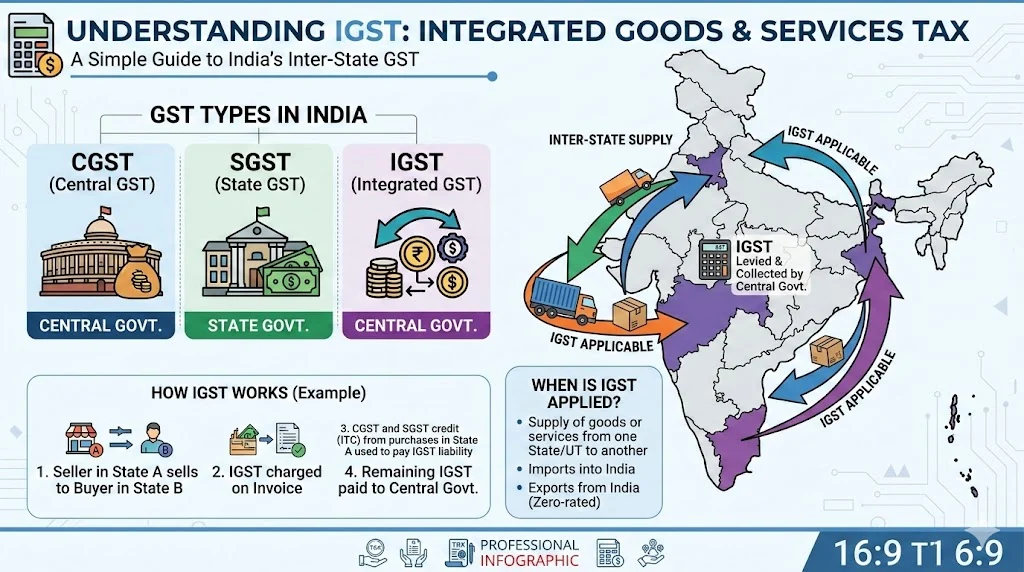

IGST full form is Integrated Goods and Services Tax.
It is a type of GST charged on the supply of goods and services between different states in India or on imports and exports.
If you’ve ever looked at a GST invoice and wondered what “IGST” stands for, you’re not alone. Whether you’re a business owner, student, freelancer, or simply trying to understand taxation in India, knowing the IGST full form can save you confusion—and money.
Unlike regular taxes that apply within a state, IGST comes into play when goods or services cross state borders. Therefore, understanding how it works is essential for compliance, billing accuracy, and smart financial planning.
Let’s break it down in simple, clear language.
Although it may look like just another tax abbreviation, IGST plays a crucial role in India’s unified GST system. In this guide, you’ll learn what IGST means, how it works, when it applies, how it’s calculated, and how it differs from CGST and SGST.
What Is IGST? (Simple Explanation)
Integrated Goods and Services Tax (IGST) is levied on:
- Inter-state transactions (one state to another)
- Imports into India
- Exports (though exports are zero-rated)
In other words, whenever goods or services move across state lines, IGST generally applies.
For example:
- If a business in Maharashtra sells goods to a buyer in Karnataka, IGST is charged.
- If a company imports goods from outside India, IGST is applicable at customs.
Why Was IGST Introduced?
Before GST was implemented in 2017, India had a complex indirect tax system. However, to simplify taxation and eliminate cascading taxes (tax on tax), the government introduced the GST regime.
As a result, IGST was created to:
- Ensure seamless tax flow between states
- Avoid double taxation
- Enable smooth input tax credit adjustments
- Create a unified national market
Therefore, IGST acts as a bridge between central and state governments in inter-state transactions.
How IGST Works in the GST System
India’s GST system includes three main components:
- CGST – Central Goods and Services Tax
- SGST – State Goods and Services Tax
- IGST – Integrated Goods and Services Tax
Here’s how they apply:
| Transaction Type | Tax Applicable |
|---|---|
| Within same state | CGST + SGST |
| Between different states | IGST |
| Import of goods/services | IGST |
| Export of goods/services | Zero-rated (IGST refundable) |
Example:
If GST rate is 18%:
- Intra-state sale → 9% CGST + 9% SGST
- Inter-state sale → 18% IGST
IGST Calculation Example
Let’s understand IGST calculation with a practical example.
Scenario:
A seller in Delhi sells goods worth ₹50,000 to a buyer in Gujarat.
GST rate = 18%
Calculation:
- IGST = 18% of ₹50,000
- IGST = ₹9,000
- Total invoice value = ₹59,000
Therefore, the buyer pays ₹59,000, and the seller remits ₹9,000 as IGST to the government.
How IGST Is Shared Between Governments
One of the most interesting aspects of IGST is revenue distribution.
Here’s how it works:
- The central government collects IGST.
- Later, it distributes the appropriate share to the destination state (where goods/services are consumed).
Because GST is destination-based, the tax revenue goes to the state where consumption happens—not where production occurs.
When Does IGST Apply?
IGST is applicable in the following situations:
- Sale of goods between two different states
- Online services provided across state borders
- E-commerce inter-state sales
- Import of goods
- Supply to Special Economic Zones (SEZs)
However, if both buyer and seller are registered in the same state, IGST does not apply.
IGST vs CGST vs SGST – Key Differences
Understanding the difference helps avoid tax filing errors.
| Feature | IGST | CGST | SGST |
|---|---|---|---|
| Full Form | Integrated GST | Central GST | State GST |
| Applies To | Inter-state | Intra-state | Intra-state |
| Collected By | Central Govt | Central Govt | State Govt |
| Revenue Shared? | Yes | No | No |
| Example | Delhi → Kerala | Mumbai → Pune | Mumbai → Pune |
Real-World Usage Examples
1️⃣ Business-to-Business (B2B)
A company in Tamil Nadu sells machinery to a firm in Telangana.
→ IGST is charged.
2️⃣ E-Commerce Sale
A seller in Rajasthan sells through Amazon to a buyer in West Bengal.
→ IGST applies.
3️⃣ Import Case
A business imports electronic goods from China.
→ IGST is charged at customs.
Input Tax Credit (ITC) Under IGST
One major advantage of IGST is seamless input tax credit.
For instance:
- A business paying IGST on purchases can claim credit against IGST liability.
- Excess IGST credit can be adjusted against CGST or SGST.
Adjustment Order:
- IGST credit → IGST liability
- Remaining → CGST
- Remaining → SGST
Because of this structure, tax cascading is minimized.
Common Mistakes Businesses Make with IGST
Even though IGST seems straightforward, errors can occur.
Avoid These Mistakes:
- Charging CGST + SGST instead of IGST for inter-state sales
- Incorrect place of supply determination
- Filing wrong GST return type
- Not claiming eligible input tax credit
Therefore, understanding place-of-supply rules is crucial.
Advantages of IGST
- Simplifies inter-state taxation
- Reduces tax evasion
- Ensures smoother credit flow
- Promotes nationwide trade
- Supports transparent compliance
Additionally, IGST eliminates earlier barriers that complicated cross-state commerce.
Frequently Asked Questions (FAQ)
1. What is the full form of IGST?
IGST stands for Integrated Goods and Services Tax.
2. When is IGST charged?
It is charged on inter-state transactions and imports.
3. Who collects IGST?
The central government collects it and later distributes the state’s share.
4. Is IGST applicable on exports?
Exports are zero-rated, but IGST may be paid and later claimed as a refund.
5. What is the current IGST rate?
IGST rates depend on the product or service and usually match GST slabs (5%, 12%, 18%, 28%).
6. Can IGST input credit be claimed?
Yes, eligible businesses can claim IGST input tax credit.
7. What happens if IGST is charged wrongly?
The taxpayer may need to correct the invoice and adjust returns accordingly.
8. Is IGST higher than CGST or SGST?
No. IGST equals the combined total of CGST and SGST.
Conclusion: Key Takeaways About IGST Full Form
- IGST stands for Integrated Goods and Services Tax
- It applies to inter-state and import transactions
- The central government collects and distributes it
- It ensures seamless input tax credit flow
- IGST equals the combined rate of CGST + SGST
Ultimately, IGST plays a vital role in India’s unified GST structure. Therefore, whether you’re a student, entrepreneur, or tax professional, understanding IGST ensures better compliance and smarter financial management.