
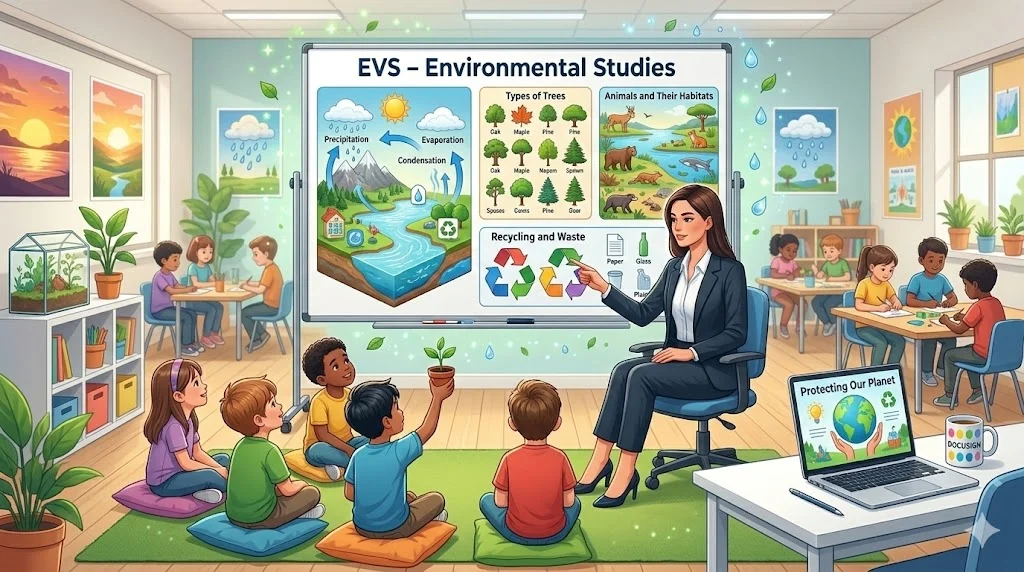

EVS stands for Environmental Studies.
It is an interdisciplinary subject taught mainly in primary school that helps students learn about the environment, nature, society, health, and the relationship between humans and their surroundings.
Have you ever come across the subject EVS in school textbooks or academic syllabi and wondered what it actually means? Students encounter this abbreviation frequently in primary education, especially in subjects that teach about nature, society, and the world around us. While it may seem like a simple acronym, EVS plays an important role in shaping a child’s understanding of the environment and responsible living.
In fact, EVS is one of the earliest subjects designed to help students understand how humans, animals, plants, and the environment are connected. Therefore, learning its full form and purpose helps both students and parents better appreciate its value in education.
Although EVS is most commonly associated with school education, the concept goes beyond textbooks. In reality, it encourages environmental awareness, sustainability, and responsible behavior toward the planet.
What Is EVS? (Understanding Environmental Studies)
Environmental Studies, commonly abbreviated as EVS, focuses on teaching students about their natural and social surroundings. Instead of concentrating on one topic alone, EVS combines multiple subjects to create a broader understanding of the world.
For example, lessons may include topics such as:
- Plants and animals
- Water and air
- Family and community
- Health and hygiene
- Natural resources
- Pollution and conservation
Because of this interdisciplinary approach, EVS helps young learners connect classroom knowledge with everyday life.
Origin and Development of EVS as a School Subject
EVS became widely recognized as an academic subject during educational reforms that emphasized holistic learning. Instead of teaching science and social studies separately in early grades, educators began combining them into a single subject.
Why EVS Was Introduced in Schools
Several educational goals led to the introduction of EVS:
- Encourage environmental awareness from a young age
- Promote practical learning and observation
- Develop critical thinking about nature and society
- Foster responsible behavior toward the environment
As a result, EVS is now a core subject in many primary school curricula, especially in countries such as India and neighboring regions.
Why EVS Is Important for Students
Environmental Studies provides children with foundational knowledge about the world they live in. More importantly, it encourages them to become responsible citizens.
Key Benefits of Studying EVS
- 🌍 Builds awareness about environmental protection
- 🌱 Encourages sustainable habits
- 🧠 Develops curiosity about nature and science
- 🤝 Teaches social responsibility and community values
- 💧 Helps students understand natural resources
Consequently, students gain both academic knowledge and practical life skills.
Topics Commonly Covered in EVS
EVS includes a wide variety of subjects related to everyday life and the environment.
Major EVS Topics
- Plants and animals
- Weather and seasons
- Water resources
- Food and nutrition
- Family and community
- Transportation
- Environmental protection
- Pollution and conservation
Because these topics relate directly to daily life, students can easily observe and understand them.
How EVS Is Used in Real Life
Environmental Studies is not limited to classroom learning. Instead, it encourages students to observe their surroundings and apply knowledge in practical situations.
Examples of EVS in Daily Life
- Learning how to save water at home
- Understanding why planting trees is important
- Practicing proper waste disposal
- Keeping surroundings clean and hygienic
- Protecting animals and natural habitats
Therefore, EVS plays a significant role in shaping environmentally responsible behavior.
Tone and Context of EVS Usage
The abbreviation EVS is typically used in educational and academic contexts. However, the meaning remains consistent across different situations.
1. Educational Tone
Most commonly used in schools and academic discussions.
Example:
“Today we have an EVS class about water conservation.”
2. Informational Tone
Used in books, study materials, and educational resources.
Example:
“EVS helps students understand their environment.”
3. Professional or Academic Tone
Sometimes used in curriculum design or teaching methods.
Example:
“The EVS syllabus focuses on environmental awareness.”
Example Sentences Using EVS
| Context | Example Sentence | Purpose |
|---|---|---|
| School timetable | “Our EVS class starts at 10 AM.” | Academic |
| Homework discussion | “The EVS project is about plants.” | Educational |
| Teacher explanation | “EVS teaches us how to protect nature.” | Informational |
| School syllabus | “EVS is taught from grade 1 to grade 5.” | Curriculum |
Comparison: EVS vs Similar Academic Terms
Sometimes EVS is confused with related subjects. However, each term has its own focus.
EVS vs Environmental Science
| EVS | Environmental Science |
|---|---|
| Introductory subject | Advanced scientific field |
| Taught in primary school | Taught in higher education |
| Combines social and natural topics | Focuses mainly on science |
EVS vs Science
| EVS | Science |
|---|---|
| Broad environmental learning | Scientific experiments and theories |
| Includes social topics | Focuses on physics, chemistry, biology |
| Early education subject | Continues through higher grades |
EVS vs Social Studies
| EVS | Social Studies |
|---|---|
| Environment-focused | Society and history focused |
| Includes nature topics | Includes politics and geography |
| Primary school level | Middle and higher grades |
Alternate Meanings of EVS
Although Environmental Studies is the most common meaning, the abbreviation EVS can represent other terms in different fields.
Other Possible EVS Full Forms
| EVS Full Form | Field |
|---|---|
| Environmental Studies | Education |
| Electronic Voting System | Technology / Politics |
| Electric Vehicle System | Automotive engineering |
| Emergency Vehicle System | Transportation |
However, in school education, EVS almost always refers to Environmental Studies.
Professional and Related Terms
Several related terms are often discussed alongside EVS.
Common Related Terms
- Environmental Science
- Ecology
- Sustainability
- Biodiversity
- Conservation
- Climate awareness
Understanding these terms helps expand the knowledge introduced through EVS.
Do’s and Don’ts When Studying EVS
Do
- Observe your environment carefully
- Participate in nature-related activities
- Practice eco-friendly habits
- Ask questions about the environment
Don’t
- Ignore environmental issues
- Waste natural resources
- Treat EVS as only a theoretical subject
Frequently Asked Questions (FAQ)
1. What is the full form of EVS?
EVS stands for Environmental Studies, a subject that teaches students about nature, society, and environmental responsibility.
2. Why is EVS taught in primary schools?
It helps children understand their surroundings and develop awareness about environmental protection.
3. What topics are included in EVS?
Common topics include plants, animals, water, pollution, health, family, and community.
4. Is EVS the same as Environmental Science?
Not exactly. EVS is a basic subject for young students, while Environmental Science is a more advanced academic discipline.
5. In which grades is EVS taught?
EVS is usually taught from Grade 1 to Grade 5 in many school systems.
6. Why is EVS important for society?
It encourages environmental awareness and responsible behavior toward nature.
7. Can EVS help protect the environment?
Yes. By teaching sustainable habits early, EVS helps students become environmentally conscious citizens.
8. Are there other meanings of EVS?
Yes. EVS can also mean Electronic Voting System or Electric Vehicle System, depending on the context.
Why EVS Matters More Than Ever Today
Environmental challenges such as climate change, pollution, and resource depletion have made environmental education extremely important. Because of this, EVS plays a crucial role in preparing younger generations to care for the planet.
Conclusion: Key Takeaways About EVS Full Form
- EVS stands for Environmental Studies
- It teaches students about nature, society, and environmental responsibility
- The subject combines science, social awareness, and practical learning
- EVS encourages eco-friendly habits and sustainability
- Early environmental education helps create responsible global citizens
Ultimately, EVS is not just a school subject—it is a foundation for understanding and protecting the world around us.