
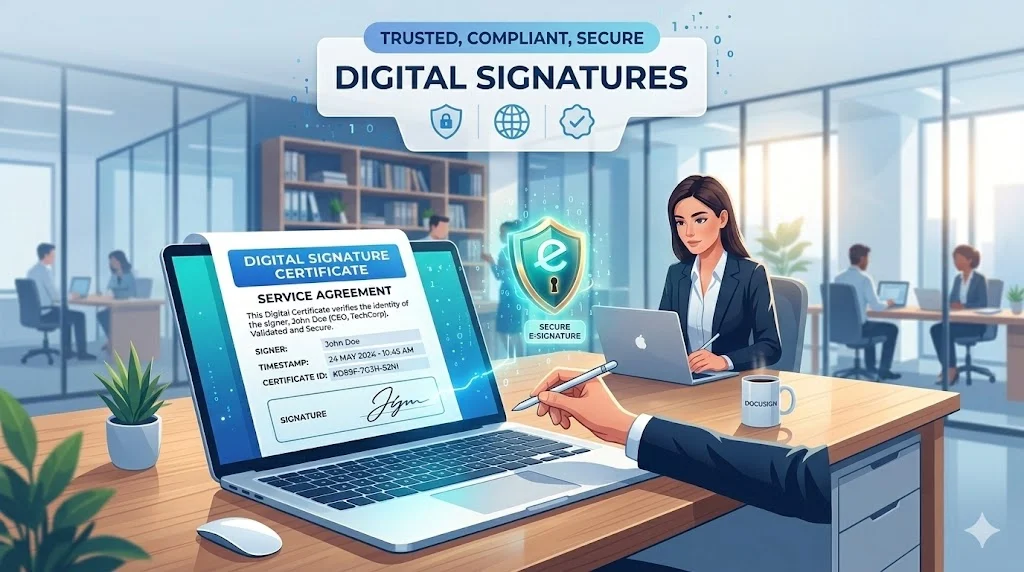

DSC full form is Digital Signature Certificate.
A Digital Signature Certificate is a secure digital key issued by authorized certifying authorities to verify the identity of the certificate holder and enable secure, legally valid electronic signatures.
If you’ve ever filled out an online government form, applied for a tender, filed income tax returns, or signed a document digitally, you’ve probably come across the term DSC. At first glance, it may look like just another abbreviation. However, in the world of digital authentication and online security, DSC plays a powerful and essential role.
So, what does DSC actually mean? Why is it important? And where is it used?
Let’s break it down clearly and practically.
Although it sounds technical, understanding DSC is simpler than it seems. In this guide, we’ll explore its meaning, origin, types, real-world usage, tone and context, comparisons with similar terms, and frequently asked questions.
What Is DSC? (Digital Signature Certificate Explained Simply)
A Digital Signature Certificate (DSC) is an electronic document that proves your identity online. Essentially, it works like a digital version of your handwritten signature or identity proof.
In other words, whenever you sign a document using DSC, you are confirming:
- ✅ The document was signed by you
- ✅ The document hasn’t been altered after signing
- ✅ The signature is legally valid
Therefore, DSC ensures security, authenticity, and integrity in digital transactions.
Origin of DSC (Where Did It Come From?)
As internet usage expanded and businesses moved online, governments needed a secure way to verify digital identities. Consequently, Digital Signature Certificates were introduced under electronic transaction laws.
For example:
- In India, DSCs are governed under the Information Technology Act, 2000
- Globally, similar systems exist under electronic signature regulations
Because of rising cyber threats and identity fraud, digital authentication became essential. As a result, DSC is now widely used in e-governance, taxation, corporate compliance, and secure communications.
Why Is DSC Important?
In today’s digital world, security is not optional—it’s necessary. Without proper authentication, online documents can be tampered with or misused.
A DSC helps by:
- 🔐 Protecting sensitive data
- 📄 Making documents legally enforceable
- 🧾 Enabling paperless transactions
- 🌍 Supporting secure online communication
- ⚖️ Ensuring compliance with government regulations
Moreover, many official portals now require DSC for access or submission.
Where Is DSC Used in Real Life?
Digital Signature Certificates are commonly used in professional and official environments.
Common Uses of DSC
- Filing income tax returns
- Company registration and compliance
- GST filings
- E-tendering and government contracts
- Signing PDFs and legal documents
- Ministry of Corporate Affairs (MCA) filings
- EPFO and other government portals
Because of these applications, DSC has become essential for business owners, company directors, chartered accountants, and legal professionals.
Types of DSC (Classification Explained)
Digital Signature Certificates are issued in different classes depending on usage and verification level.
1. Class 1 DSC
- Basic identity verification
- Used for email communication
- Low-level security
2. Class 2 DSC (Previously Common)
- Used for company filings
- Identity verified against official records
- Moderate security level
3. Class 3 DSC
- Highest level of security
- Required for e-tendering and online auctions
- In-person verification mandatory
Although classifications may change over time, higher classes generally offer stronger authentication.
Tone and Context: How Is DSC Used in Communication?
Unlike greetings or phrases, DSC is a formal and technical abbreviation. Its tone depends on the context.
1. Professional Tone
“Please submit the document with a valid DSC.”
2. Instructional Tone
“You must register your DSC on the portal before filing.”
3. Compliance-Oriented Tone
“DSC is mandatory for company directors.”
Because of its legal importance, DSC is rarely used casually. Instead, it appears in official documents, emails, and compliance instructions.
Labeled Examples of DSC Usage
| Context | Example Sentence | Tone |
|---|---|---|
| Tax Filing | “Upload the return using your DSC.” | Professional |
| Government Portal | “Register your DSC before proceeding.” | Instructional |
| Corporate Filing | “The director’s DSC is required.” | Compliance-based |
| E-Tender | “Bids must be signed with a Class 3 DSC.” | Formal |
How Does a DSC Work? (Simple Explanation)
A Digital Signature Certificate works using public key infrastructure (PKI) technology.
Here’s how it functions:
- A certifying authority issues a digital key pair (public and private keys).
- The private key remains securely with the user.
- The public key is available to verify authenticity.
- When you sign a document digitally, encryption ensures security.
- If the document is altered, the signature becomes invalid.
Therefore, DSC protects both identity and document integrity.
Comparison: DSC vs Similar Terms
DSC vs Digital Signature
| DSC | Digital Signature |
|---|---|
| Certificate verifying identity | Actual electronic signature |
| Issued by certifying authority | Created using DSC |
| Required for authentication | Used to sign documents |
Simply put, DSC enables digital signatures.
DSC vs e-Sign
| DSC | e-Sign |
|---|---|
| Requires USB token or stored certificate | Often Aadhaar/OTP-based |
| Higher security | Convenient for individuals |
| Common in corporate use | Common in personal use |
While both allow online signing, DSC is generally preferred for corporate and government compliance.
Alternate Meanings of DSC
Although Digital Signature Certificate is the most common full form in compliance and IT contexts, DSC can also stand for:
- District Selection Committee
- Diploma in Surgical Care
- Data Science Conference
- Direct Sales Company
However, context determines the correct meaning. In legal and digital security discussions, DSC almost always refers to Digital Signature Certificate.
Professional Alternatives to DSC
In formal writing, instead of using only the abbreviation, you can write:
- Digital Signature Certificate (first reference)
- Digital authentication certificate
- Electronic signature certificate
- Secure digital credential
After the first mention, using “DSC” is acceptable.
Do’s and Don’ts of Using DSC
Do
- Ensure your DSC is valid and not expired
- Protect your private key
- Use authorized certifying authorities
Don’t
- Share your private key
- Use expired certificates
- Upload unsigned documents when DSC is mandatory
Frequently Asked Questions (FAQ)
1. What is the full form of DSC?
DSC stands for Digital Signature Certificate.
2. Is DSC legally valid?
Yes, DSC is legally valid under electronic transaction laws in many countries.
3. Who needs a DSC?
Company directors, business owners, tax professionals, and anyone filing certain government documents online.
4. How long is a DSC valid?
Typically, DSCs are valid for 1–3 years, depending on the issuing authority.
5. Is DSC mandatory for GST filing?
In many cases, yes—especially for companies and LLPs.
6. Can individuals use DSC?
Yes, individuals can obtain and use DSC for secure digital transactions.
7. What happens if my DSC expires?
You must renew it through a certifying authority before using it again.
8. Is DSC safe?
Yes, provided the private key is kept secure and not shared.
Why DSC Matters in Today’s Digital World
As businesses increasingly move online, security becomes a priority. Digital Signature Certificates eliminate paperwork, reduce fraud, and streamline compliance processes. Consequently, DSC has become a cornerstone of secure digital communication.
Conclusion: Key Takeaways About DSC Full Form
- DSC full form is Digital Signature Certificate
- It verifies identity and enables legally valid electronic signatures
- Widely used in taxation, corporate compliance, and government filings
- Comes in different classes based on security level
- Ensures authenticity, security, and document integrity
Ultimately, DSC is not just a technical requirement—it is a foundation of trust in digital transactions.