
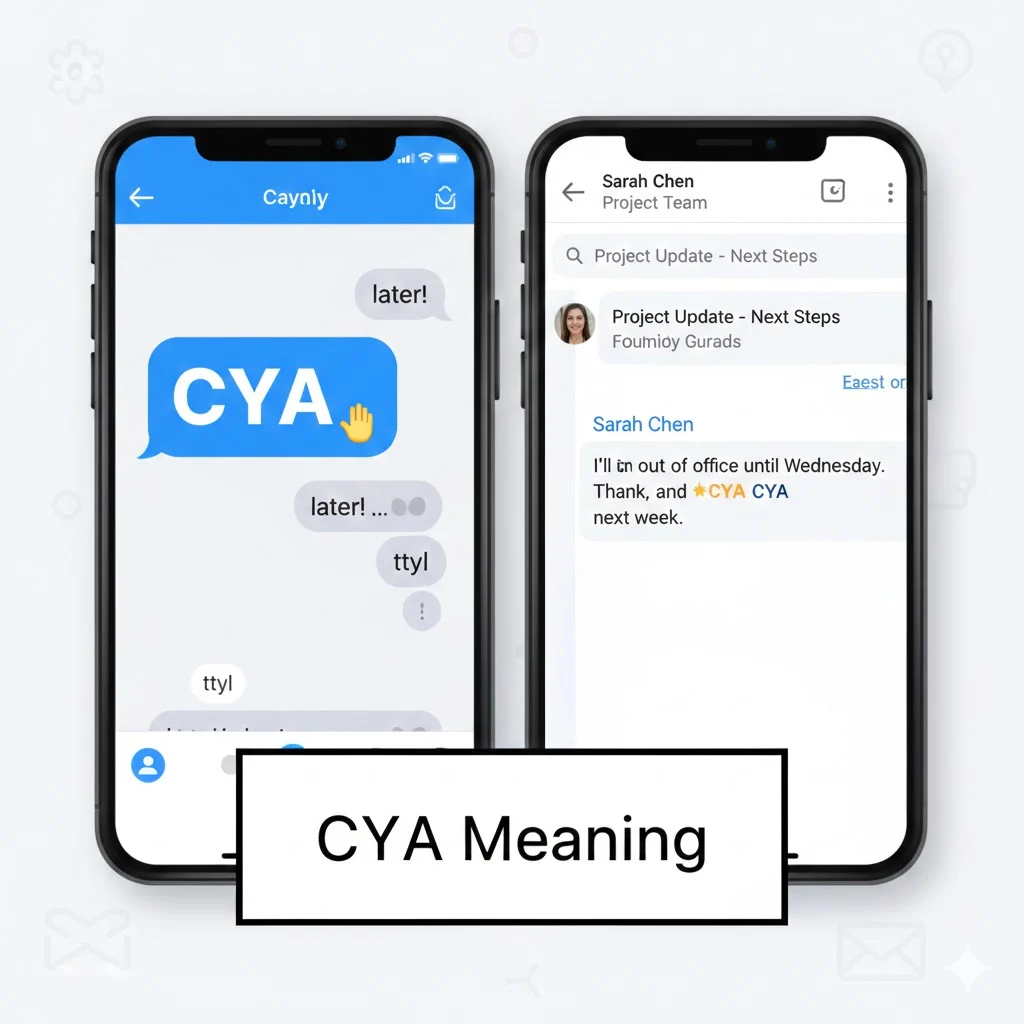

CYA is an abbreviation that commonly means “See You” in casual conversation.
However, in professional or workplace contexts, CYA can also mean “Cover Your A”**, referring to protecting oneself from blame or liability.
Ever received a message that just said “CYA” and paused for a second trying to decode it? You’re not alone. In today’s fast-paced texting culture, abbreviations dominate conversations—and CYA is one of those short but surprisingly versatile acronyms.
However, depending on context, CYA meaning can shift completely. Sometimes it’s friendly. Other times, it’s professional. And occasionally, it carries a more sarcastic or even defensive tone.
Let’s break it down clearly so you’ll never misunderstand it again.
Throughout this guide, we’ll explore the origins of CYA, how it’s used in texting and business communication, tone differences, examples, comparisons with similar abbreviations, and practical tips for using it correctly.
What Does CYA Mean in Texting?
Most commonly, CYA means “See You.”
It’s a shortened, informal way to say goodbye in text messages, online chats, and social media.
✅ Casual Example:
“Heading out now. CYA later!”
In this case, the tone is:
- Friendly
- Informal
- Relaxed
Because texting culture favors speed and simplicity, abbreviations like CYA make conversations quicker and more conversational.
CYA Meaning in Professional Settings (Very Different!)
Here’s where things get interesting.
In workplace slang, CYA often stands for “Cover Your A” (Cover Your Ass)**.
This phrase refers to taking precautions to protect yourself from blame, criticism, or legal responsibility.
⚠️ Workplace Example:
“Make sure to document everything. It’s a CYA move.”
In this context, the tone is:
- Strategic
- Defensive
- Sometimes cynical
Therefore, understanding the setting is crucial. While texting CYA is harmless, workplace CYA can carry a much heavier implication.
Origin of CYA
1️⃣ Texting Culture Origin
As digital communication expanded in the late 1990s and early 2000s, abbreviations like:
- BRB (Be Right Back)
- LOL (Laugh Out Loud)
- TTYL (Talk To You Later)
became common. Naturally, “See Ya” evolved into CYA.
2️⃣ Workplace Slang Origin
Meanwhile, the phrase “Cover Your A**” dates back to corporate and military slang. Over time, professionals abbreviated it to CYA for discretion in emails or casual conversation.
Because both meanings use the same acronym, context determines interpretation.
How to Tell Which CYA Meaning Is Intended
Understanding CYA depends on three main factors:
1. Platform
- Text message → Likely “See You”
- Workplace email → Possibly “Cover Your A**”
2. Tone of Conversation
- Friendly goodbye → “See You”
- Risk management discussion → “Cover Yourself”
3. Audience
- Friends → Casual meaning
- Colleagues → Strategic meaning
Tone Variations of CYA
The tone of CYA can change dramatically depending on usage.
🟢 Friendly Tone
“Great seeing you today! CYA tomorrow 😊”
Feels casual and warm.
🟡 Neutral Tone
“Meeting’s done. CYA next week.”
Simple and straightforward.
🔵 Professional/Strategic Tone
“Send that confirmation email as a CYA.”
Protective and cautious.
🔴 Sarcastic Tone
“Oh sure, another CYA email.” 😒
Implies frustration or annoyance.
Labeled Examples of CYA Usage
| Context | Example Sentence | Meaning | Tone |
|---|---|---|---|
| Text message | “CYA tonight!” | See You | Friendly |
| Social media | “Had fun! CYA soon!” | See You | Casual |
| Office email | “This report is pure CYA.” | Cover Your A** | Strategic |
| Corporate chat | “Let’s document this—CYA.” | Cover Yourself | Defensive |
| Informal goodbye | “Alright, CYA!” | See You | Relaxed |
CYA vs Similar Abbreviations
Understanding related abbreviations helps avoid confusion.
CYA vs TTYL
| CYA | TTYL |
|---|---|
| See You | Talk To You Later |
| Often in person or soon | Future conversation |
| Short and flexible | Slightly more specific |
CYA vs BRB
| CYA | BRB |
|---|---|
| Goodbye | Temporary absence |
| Ends conversation | Pauses conversation |
CYA vs FYI (Work Context)
| CYA | FYI |
|---|---|
| Protective action | Informational |
| Defensive tone possible | Neutral tone |
Is CYA Appropriate in Professional Communication?
It depends.
✔️ Safe Situations:
- Informal internal chats
- Casual team environments
- Friendly office culture
❌ Risky Situations:
- Formal client emails
- Executive-level communication
- Legal or compliance documents
In professional writing, it’s often better to spell out intentions clearly rather than rely on slang.
Polite or Professional Alternatives to CYA
If you want to avoid ambiguity, here are better options.
For “See You”
- See you later
- See you soon
- Talk soon
- Until next time
For “Cover Yourself”
- For documentation purposes
- As a precaution
- For clarity and record-keeping
- To ensure compliance
Using clear language prevents misunderstandings.
Alternate Meanings of CYA (Rare but Possible)
Although uncommon, CYA can occasionally appear in:
- Business shorthand without profanity (Cover Your Actions)
- Informal branding or usernames
- Regional slang
Still, the two main meanings remain dominant.
Why CYA Is So Popular in Digital Culture
Shortened communication thrives because:
- Attention spans are shorter
- Messaging is fast-paced
- Informality is normalized
- Abbreviations feel conversational
Consequently, acronyms like CYA continue to thrive in texting and workplace slang.
Do’s and Don’ts of Using CYA
✅ Do:
- Consider your audience
- Understand the context
- Keep tone in mind
❌ Don’t:
- Use it in formal legal communication
- Assume everyone knows the meaning
- Use it sarcastically in sensitive situations
Frequently Asked Questions (FAQ)
1. What does CYA mean in texting?
In texting, CYA usually means “See You.”
2. What does CYA mean at work?
In professional settings, it often means “Cover Your A**,” referring to protecting yourself from blame.
3. Is CYA rude?
Not necessarily. However, workplace usage can feel cynical depending on tone.
4. Can CYA mean both hello and goodbye?
No. It typically functions as a goodbye abbreviation.
5. Is CYA formal?
No. It’s informal and slang-based.
6. Should I use CYA in professional emails?
Only in very casual team settings. Otherwise, avoid it.
7. How do you respond to CYA?
Simply reply with “CYA,” “See you,” or a specific time reference.
8. Why does CYA have two meanings?
Because texting culture and workplace slang evolved separately but used the same acronym.
Why Understanding CYA Matters
Misinterpreting CYA can lead to awkward or confusing situations. For instance, reading “CYA” in a workplace memo as “See You” could change the tone entirely.
Therefore, paying attention to context protects both clarity and communication flow.
Conclusion: Key Takeaways About CYA Meaning
- CYA most commonly means “See You” in texting
- In professional settings, it can mean “Cover Your A”**
- Context determines tone and meaning
- It is informal and should be used carefully in workplaces
- Clear alternatives help avoid misunderstandings
Ultimately, CYA is short—but its meaning isn’t always simple.