
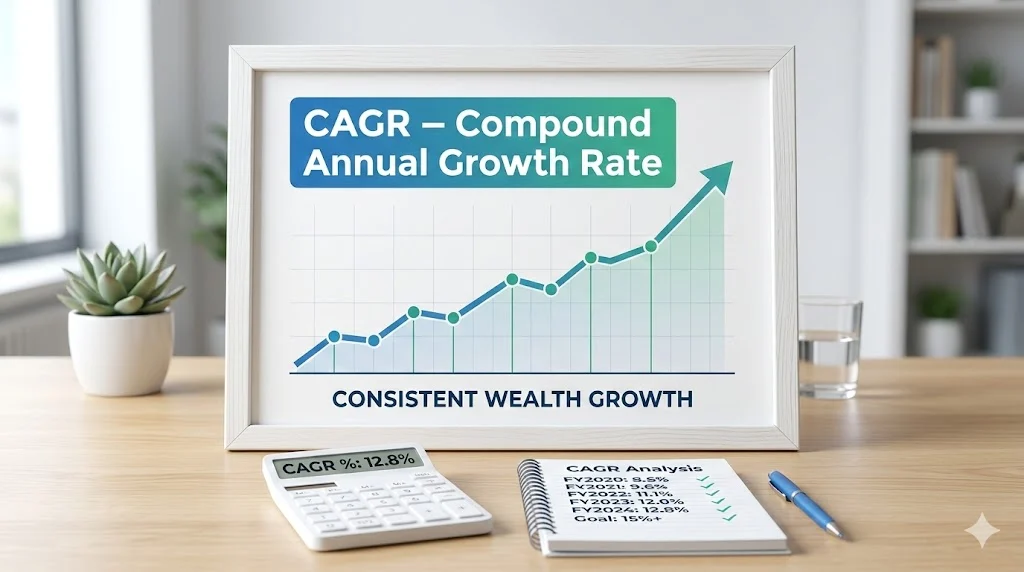

CAGR full form is Compound Annual Growth Rate.
It represents the average annual growth rate of an investment over a specific period of time, assuming the profits were reinvested each year.In simple terms, CAGR shows how fast something grows per year on average, even if the actual growth fluctuates year to year.
If you’ve ever looked at investment returns, startup growth charts, or stock market reports, you’ve probably seen the term CAGR. It appears in financial news, annual reports, mutual fund comparisons, and even cryptocurrency analysis. But what does it actually mean?
More importantly, why do investors and analysts rely on it so heavily?
Let’s break it down in simple, practical language so you can confidently understand — and even calculate — CAGR yourself.
Whether you’re evaluating stocks, comparing mutual funds, analyzing business performance, or studying economic data, understanding CAGR helps you make smarter financial decisions.
What Is CAGR? (Simple Explanation)
At its core, CAGR measures steady annual growth. However, unlike simple average growth, it accounts for compounding.
Why That Matters
Imagine your investment grows:
- 10% in Year 1
- 5% in Year 2
- 15% in Year 3
Instead of averaging these percentages directly, CAGR smooths the growth into one single annual rate that reflects compounding effects.
As a result, you get a more realistic performance metric.
CAGR Full Form Explained
CAGR = Compound Annual Growth Rate
Let’s break that down:
- Compound → Growth builds on previous growth
- Annual → Measured per year
- Growth Rate → Percentage increase over time
Therefore, CAGR tells you the consistent yearly growth rate that would take an initial value to a final value over a certain number of years.
CAGR Formula
The formula for CAGR is:CAGR=(Initial ValueFinal Value)Number of Years1−1
Although the formula looks technical, the idea behind it is straightforward.
In Plain English:
- Divide the ending value by the starting value
- Take the root based on the number of years
- Subtract 1
- Convert to percentage
CAGR Calculation Example
Let’s understand with a practical example.
Example:
- Initial Investment: $10,000
- Final Value after 5 years: $20,000
Now apply the formula:CAGR=(20000/10000)1/5−1
CAGR ≈ 14.87%
That means your investment grew at an average annual rate of 14.87% over five years.
Labeled CAGR Example Table
| Initial Value | Final Value | Time Period | CAGR |
|---|---|---|---|
| $10,000 | $20,000 | 5 years | 14.87% |
| $5,000 | $8,000 | 3 years | 17.14% |
| $50,000 | $75,000 | 4 years | 10.67% |
| $1,00,000 | $2,00,000 | 6 years | 12.25% |
This table helps you see how growth varies depending on time and scale.
Why CAGR Is Important
CAGR is widely used because it provides clarity. Instead of looking at inconsistent yearly returns, you get one smooth growth rate.
Key Benefits of CAGR
- 📈 Makes investment comparison easier
- 📊 Eliminates volatility confusion
- 🧮 Accounts for compounding
- 🏦 Used in stocks, mutual funds, ETFs, startups, and GDP growth
For instance, when comparing two mutual funds, investors often choose the one with higher CAGR over a long period.
Real-World Uses of CAGR
CAGR isn’t limited to stock markets. In fact, it’s used in multiple industries.
Common Applications
- Stock market performance
- Mutual fund returns
- Company revenue growth
- Startup valuation growth
- Real estate appreciation
- Population growth analysis
- GDP growth comparisons
Because of its versatility, CAGR is a core financial metric globally.
CAGR vs Simple Growth Rate
Although both measure growth, they are not the same.
| CAGR | Simple Growth Rate |
|---|---|
| Accounts for compounding | Does not consider compounding |
| Smooths volatility | May mislead over long periods |
| Best for long-term analysis | Good for short-term changes |
| More accurate performance indicator | Basic percentage change |
Therefore, for long-term investments, CAGR is generally more reliable.
CAGR vs Absolute Return
Many beginners confuse CAGR with absolute return. However, they measure different things.
Absolute Return
Shows total percentage gain or loss over a period.
CAGR
Shows average yearly compounded growth.
Example:
If an investment doubles in 5 years:
- Absolute Return = 100%
- CAGR ≈ 14.87% per year
As you can see, CAGR gives a more practical annual perspective.
Advantages of CAGR
While CAGR is popular, understanding its strengths helps you use it wisely.
✔ Advantages
- Easy comparison tool
- Smooths irregular growth
- Useful for long-term investing
- Reflects compounding accurately
Limitations of CAGR
However, CAGR has certain limitations.
✖ Limitations
- Assumes steady growth (which rarely happens)
- Ignores market volatility
- Doesn’t reflect risk
- May hide large fluctuations
Therefore, investors should use CAGR alongside other metrics like standard deviation or annual returns.
Tone & Context Usage Examples
CAGR is primarily a financial and analytical term. Unlike greetings or conversational phrases, it carries a professional tone.
Professional Context
“The company delivered a 12% CAGR over the last decade.”
Investment Discussion
“This mutual fund has a 15-year CAGR of 13.5%.”
Business Presentation
“Revenue grew at a CAGR of 18% between 2020 and 2025.”
Because of its technical nature, CAGR is rarely used casually.
How to Calculate CAGR in Excel
Although manual calculation is possible, Excel makes it easier.
Formula in Excel:
= (Ending Value / Beginning Value) ^ (1 / Years) - 1
Alternatively, you can use:
=RATE(Years, , -Beginning Value, Ending Value)
As a result, financial analysts frequently rely on spreadsheets for quick CAGR computation.
Professional Alternatives or Related Terms
While CAGR is widely accepted, similar financial terms include:
- Annualized Return
- Year-over-Year (YoY) Growth
- Average Annual Return
- Internal Rate of Return (IRR)
However, each has a slightly different calculation method and purpose.
Frequently Asked Questions (FAQ)
1. What is the full form of CAGR?
CAGR stands for Compound Annual Growth Rate.
2. What does CAGR show?
It shows the average annual growth rate of an investment over a period, assuming compounding.
3. Is CAGR better than average return?
Yes, because CAGR accounts for compounding and smooths volatility.
4. Can CAGR be negative?
Yes. If the final value is lower than the initial value, CAGR will be negative.
5. Is CAGR used only in finance?
No. It is also used in economics, business growth, real estate, and market research.
6. What is a good CAGR rate?
It depends on the investment type. For stocks, 10–15% is generally considered strong historically.
7. What is the difference between CAGR and IRR?
CAGR assumes a single investment and constant growth, while IRR accounts for multiple cash flows.
8. Why is CAGR important for investors?
Because it provides a realistic annual growth comparison over long periods.
Why CAGR Matters in Long-Term Investing
In long-term wealth creation, consistency matters more than short bursts of high returns. Consequently, CAGR helps investors focus on sustainable growth instead of temporary spikes.
Moreover, financial advisors often recommend analyzing 5-year, 10-year, or even 20-year CAGR to evaluate true performance.
Conclusion: Key Takeaways About CAGR Full Form
- CAGR full form is Compound Annual Growth Rate
- It measures average annual compounded growth
- It smooths fluctuations for easier comparison
- It is widely used in stocks, mutual funds, startups, and economics
- While powerful, it should be used alongside other metrics
Ultimately, understanding CAGR empowers you to interpret financial data with clarity and confidence.